The Yarrow Contradiction: How One Plant Does Two Opposite Things Simultaneously
- Roland Koronya


Here is the puzzle.
Yarrow stops bleeding.
Press a poultice of fresh leaf onto a wound and the bleeding slows, sometimes within minutes, a fact known to every battlefield medic from ancient Troy to the American Civil War, and one that is entirely consistent with what we know about the herb’s astringent, styptic chemistry.
This is the action that gave it nearly all of its folk names: Staunch Weed, Nosebleed, Soldier’s Woundwort, Carpenter’s Weed, this last one a useful reminder that in the days before emergency medicine, the carpenter who gashed a hand needed the plant growing at the field’s edge to be effective and immediate.
But then take a cup of hot yarrow tea at the onset of a fever. Hold the mug. Feel the warmth of it.
And within twenty minutes, something begins to happen: a faint prickling at the skin’s surface, a warmth spreading outward through the limbs, the first gathering moisture of an approaching sweat.
Yarrow, taken as a hot infusion in the presence of fever, opens the pores. It moves blood to the periphery. It induces perspiration.
It makes you sweat.
This is the herb that stops bleeding. And it also, unmistakably, moves blood outward and opens the body’s surfaces.
Contracts and releases. Closes and opens. The same plant, the same aerial parts, the same cup of tea.
How can this possibly be consistent?
The Names Tell the Story
Look at the folk names again: Staunch Weed, Nosebleed, Soldier’s Woundwort, Carpenter’s Weed, Bloodwort, Herb Militaris.
These are not decorative names. They are records of use, compressed into words and carried forward by the people who needed the plant.
The carpenter who cut himself in the workshop reached for whatever grew nearest. The soldier on the battlefield pressed yarrow onto a wound. The person with a nosebleed crushed the leaf and stuffed it into a nostril.
Every name points the same direction: this plant stops bleeding.
The mythology begins with Achilles, or more precisely, with the centaur Chiron, who in some accounts taught Achilles the healing uses of the plant that now bears his name. Thetis bathed the infant Achilles in yarrow waters to confer protection. The adult Achilles used the plant to heal the wounds of his soldiers at Troy.
Achillea millefolium carries that relationship in its Latin name still.
Pliny called it Herba militaris, the soldier’s herb. Roman legions carried it across Europe. In Britain, yarrow appears in the Anglo-Saxon Nine Herbs Charm, a tenth-century incantation for healing wounds and warding off poison, in which nine sacred plants are named and addressed.
This is some of the oldest recorded plant medicine in British history. Yarrow is there.
The Hot Tea
Now consider the fever use.
For centuries, the standard approach to a self-limiting fever in Western herbal medicine has been a hot infusion of yarrow, elderflower, and peppermint. One to two teaspoons of dried flower and leaf steeped covered for fifteen minutes in just-boiled water.
Yarrow and elderflower together open the pores and encourage perspiration. Peppermint provides its cooling volatile oil action and improves the flavour.
Taken hot, under a blanket, this formula brings on a productive sweat and supports the fever process.
But here’s what seems strange: if yarrow stops bleeding by constricting blood vessels and tightening tissues, how does it simultaneously open the pores and move blood outward to induce sweating?
These seem like opposite actions.
The Word
The technical term for what yarrow does is amphoteric, a word borrowed from chemistry meaning a substance capable of acting as either an acid or a base depending on its environment.
Applied to herbs, it describes the class of plants that regulate and normalise a physiological process rather than pushing it consistently in one direction.
Yarrow does not simply stop blood flow or simply increase it. It reads the situation and responds accordingly.
Where blood flow is excessive (a wound, a nosebleed, a heavy menstrual flow), yarrow’s styptic and astringent action brings it toward regulation.
Where blood flow is insufficient or misdirected (pooled in the core during a fever while the skin is hot and dry and airless), yarrow’s diaphoretic action redistributes it outward, opening the periphery and allowing heat to escape through the sweat.
Yarrow is a “master of fever” specifically because of its ability to move blood toward the skin or the core of the body as needed, regulating heat through blood distribution rather than through chemical suppression.
The mechanism is clear: as a diaphoretic, yarrow stimulates circulation toward the periphery, opens the pores, and stimulates sweating to allow cooling, with hot tea as the ideal preparation.
“This seems like the opposite of what you want,” one herbal text notes of the fever use, “but the heat and sweat are supporting the action your body is already taking.”
This is the vitalist principle in one sentence.
The herb is not counteracting the fever. It is supporting the body’s own attempt to complete the fever process, redistributing blood to the skin, encouraging the sweat that is the body’s cooling and clearing mechanism, allowing the febrile response to run its course cleanly.
The alternative (suppressing the fever with ibuprofen) interrupts that process mid-arc. Yarrow, taken hot, accompanies it to its natural resolution.
The Three Levels
There is a detail about yarrow’s styptic precision that sets this herb apart from every other hedgerow wound plant.
The body’s bleeding capacity exists on three levels: the capillaries, which are the smallest and most superficial vessels; the arterioles, which are intermediate; and the arteries, which are the large, actively pumping vessels whose damage constitutes a genuine medical emergency.
Most styptic herbs work effectively on the first level and usefully on the second.
Yarrow works on all three, including the third level, the arterial level.
The stories are recorded in herbal teaching: deep chainsaw wounds where yarrow was applied and used to staunch arterial bleeding until medical care was available. These are not folk exaggerations. They reflect a plant whose haemostatic constituent (achilleine) is documented to reduce clotting time by a measurable percentage even at very low doses.
The specificity is remarkable: most plants that work at the surface do not work at depth. Yarrow bridges the entire range.
The Energetic Logic
Its energetic character explains this.
The heat/excitation tissue state, which is yarrow’s primary territory, manifests in the vasculature as excess heat, excess movement, excess flow, blood that is moving too freely, too rapidly, or to the wrong place.
Yarrow’s cooling, drying, astringent energetics bring that excess back toward containment and regulation.
Whether the excess is manifesting as a bleeding wound, a fever, an inflammatory condition in the mucous membranes of the sinus or gut, or a heavy menstrual flow, the underlying pattern is the same: too much heat, too much movement, tissues that need toning and cooling.
Yarrow meets all of these presentations from the same energetic foundation.
The Signature
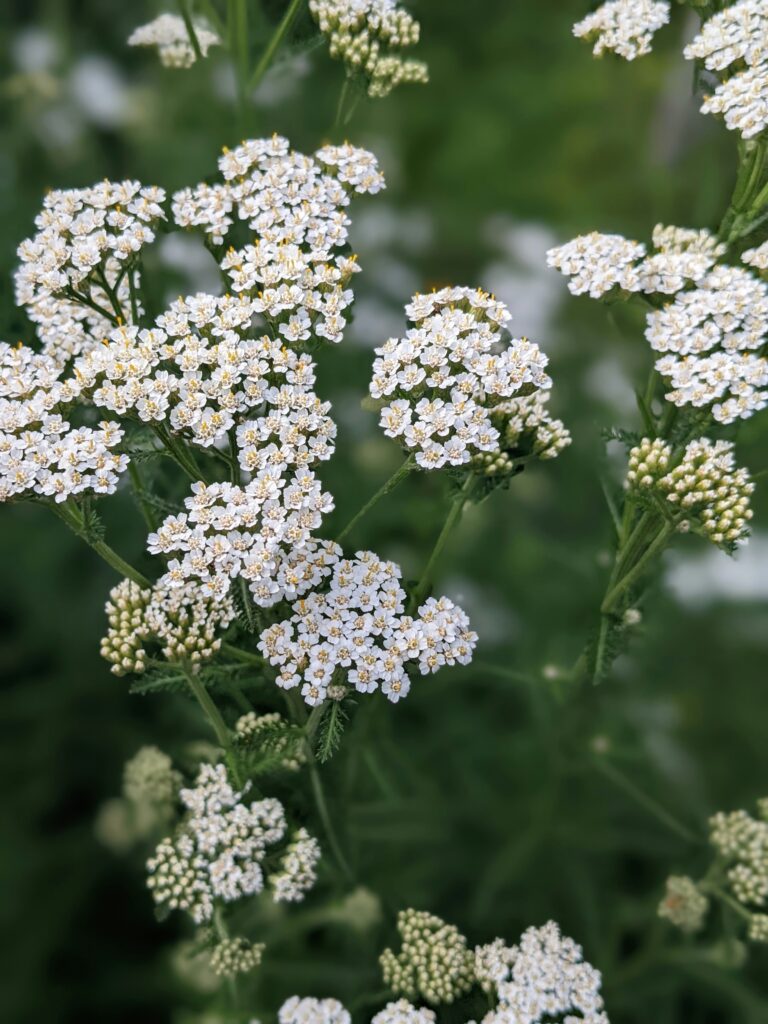
The name millefolium (thousand-leaved) refers to yarrow’s most distinctive visual character: its leaves are finely divided into a feathery tracery of tiny segments, giving the whole plant a delicate, lacework appearance.
There is a tradition in Western herbalism of reading finely divided leaves as indicating herbs with affinity for the blood and circulatory system, the branching, intricate architecture of the leaf mirroring the branching, intricate architecture of the vascular tree.
Whether one takes this reading as diagnostic or merely evocative, the correspondence is apt.
Its habitat adds a second layer. Yarrow grows on dry, well-drained ground: road verges, chalk grasslands, rough meadows, the sunny margins of paths. It does not favour the damp and lowlying.
This dry, airy preference reflects its constitutional territory: it is a herb for excess, for heat and overflow, not for depletion and deficiency. The plant that grows in the driest, most sun-exposed ground is the plant suited to the most heated, most overflowing tissue states.
The Path's Edge
Yarrow grows at the edge of almost every path in Britain.
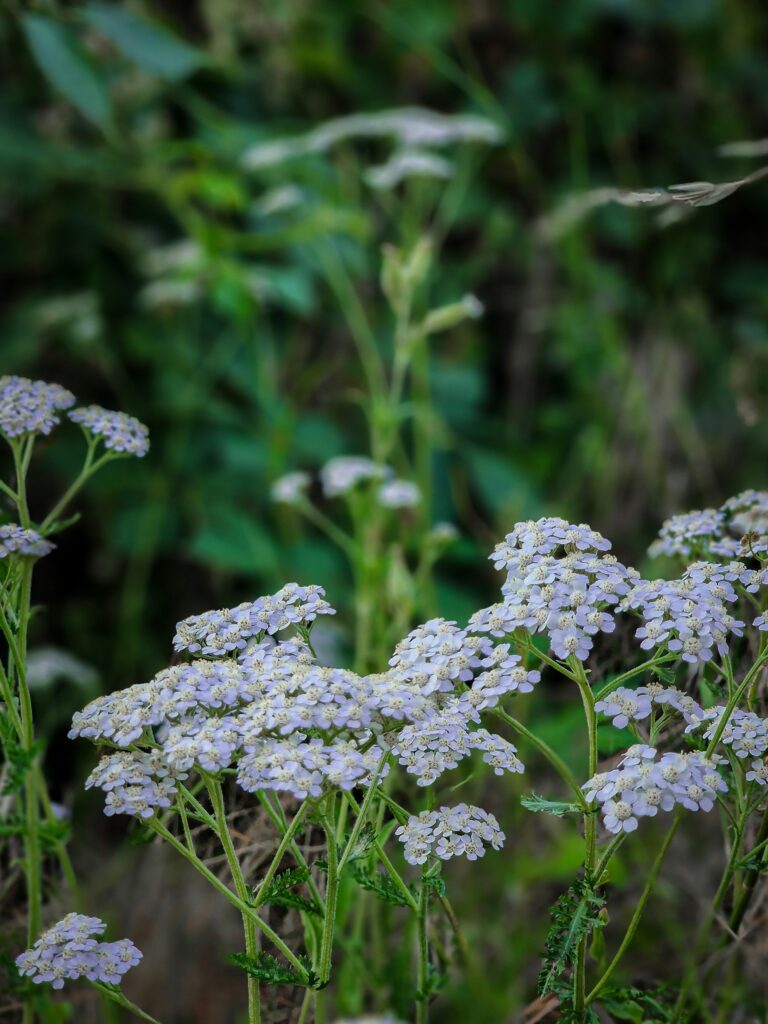
It flowers white through summer and well into autumn, flat-topped clusters of tiny blooms held above feathery leaves, modest and ubiquitous, so commonplace that the eye slides over it without registering what it is.
Few plants in this country have been more continuously and more widely used throughout human history.
Few are more casually overlooked now.
The puzzle of how it stops bleeding and opens sweating at the same time is not actually a puzzle once you understand that it is doing neither: it is reading the body’s blood distribution and normalising it.
That understanding, that a plant’s action depends on the pattern it meets, not on a fixed pharmacological effect is one of the most important shifts available in herbal thinking.
Yarrow, growing at the verge of the path outside, is as good a place as any to begin.