Ask the herbal question you've been Googling. Get an answer built around you. Ask your herbal question. Get an answer built around you.
The Green Tutor is a personalised herbal AI trained on 16 years of clinical practice. It checks every herb against your medication list before it says anything. Built for the UK. Not a course. Not a database. Not a generic chatbot.
This is
- ✓A personalised herbal AI that knows your medications
- ✓A real-time herb-drug interaction checker
- ✓UK-specific — Boots, Holland & Barrett, British Pharmacopoeia
- ✓Built on 16 years of practising herbalist knowledge
- ✓An answer to your specific question — not a generic herb summary
This is not
- ✕A course with modules, homework, or a certificate
- ✕A herb database or reference library to browse
- ✕A generic AI that searches the internet
- ✕A replacement for your GP
- ✕One-size-fits-all advice written for a notional average person
A real question. A real answer. From a real profile.
This is an actual exchange from The Green Tutor. Not a demo written to look good. The profile was set up at the start — the answer comes from it.
Can you tell me more about your headache — where it is, what it feels like (throbbing, dull, sharp), and whether anything else is going on?
Any other symptoms — fever, neck stiffness, sensitivity to light or sound, nausea, changes in vision?
A throbbing headache without fever or neck stiffness often signals congestion or circulatory pressure — sometimes with a heat element. Given your dry constitution, we want to address that without adding to dryness.
All three herbs you have are relevant here. Chamomile is the relaxant — it'll ease any nervous tension or irritation underlying the throb. Yarrow is the more active choice: it moves stagnant blood, opens peripheral circulation, and can draw congestion away from the head. Calendula adds anti-inflammatory and lymphatic support if there's any congestion in the head and neck contributing.
Try 1 part chamomile, 1 part yarrow, and half a part calendula. One tablespoon of the mix per cup, steep covered for 10–15 minutes, strain and sip warm. The cover matters — yarrow's volatile oils disperse in steam.
If the headache is severe, unusual for you, or doesn't ease within an hour or two, that's when you involve a GP rather than a herb.
It asked two questions before recommending anything. That's what a herbalist does. Every other resource would have given you a list of what chamomile "does." This one found out what you needed first.
This is built for a specific kind of person.
This works if you
- ✓Take herbs or supplements alongside prescription medication
- ✓Want a straight answer to your specific question — not another reference to look up
- ✓Feel overwhelmed by conflicting advice from books, apps, and Google
- ✓Are learning for yourself, your family, or both
- ✓Want something built for the UK — not adapted from the US
Probably not if you
- ✕Want a structured course with modules and a certificate
- ✕Prefer to browse a herb library at your own pace
- ✕Would rather work with a human herbalist directly (if you can, that's always the better option)
Tell it about you once. It remembers everything after that.
Tell it about you
Medications, sensitivities, health goals, who you're learning for. Takes 3 minutes. Does all the heavy lifting for every answer that follows.
Ask your question
In plain English. The one you Googled at 11pm. The one your GP dismissed. Start there.
Get an answer shaped to you
Not what this herb does in general. What's appropriate for you — with your medication list already checked before the answer reaches you.
Keep coming back
It remembers. Builds on what it knows. Gets more useful the longer you use it.
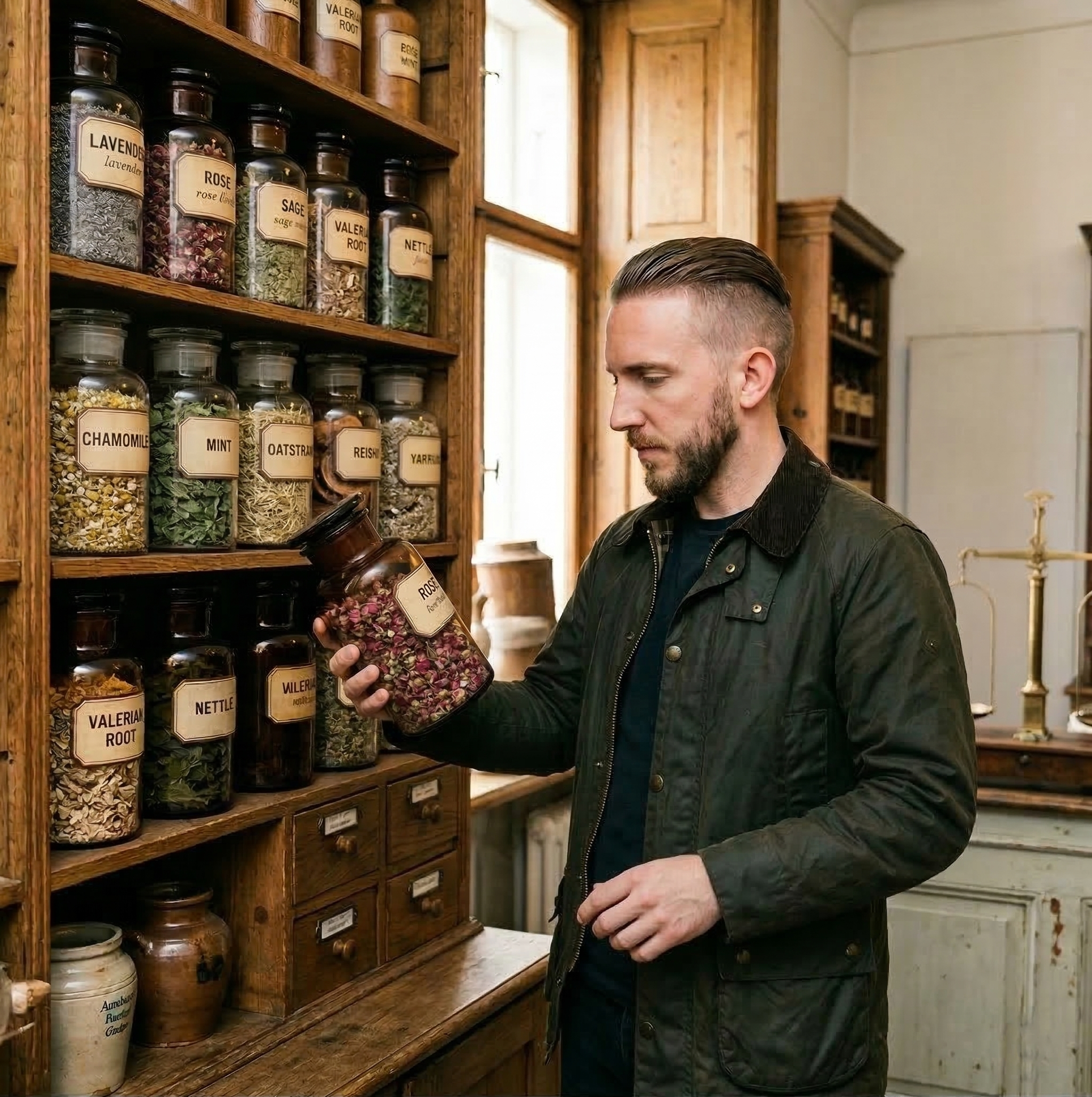
In their own words. About their actual situations.
"I had this specific question about St John's Wort and whether it would be okay with my blood pressure tablets and every time I searched I just got the same vague 'consult a healthcare professional' answer. Within about half an hour I had an actual answer. Not a hedged non-answer. An answer. I've been on the blood pressure medication for four years and nobody — not the pharmacist, not my GP — had ever gone through the herb side of things with me."
"It flagged an interaction with my levothyroxine straight away. I'd been taking ashwagandha for months — the woman in Holland & Barrett suggested it. My GP doesn't even know I take supplements because every time I've brought it up she just says to check the packet. The packet said nothing. This did."
"I did an online diploma. £380, four months, learned almost nothing useful. The Green Tutor is different because it goes in the direction I'm already going. I don't have to work out how to apply the information to me — it already knows who I am. That sounds like a small thing but it's the entire problem with every other resource I've tried."
"My nan knew all of this. She had something for everything. I kept meaning to ask her to write it down properly and I left it too late. It's the first time I've found something where the learning feels like it's building toward something rather than just collecting facts. It feels more like remembering than studying, if that makes sense."
Every resource you've tried answered the wrong question.
Your question was never "what does this herb do?" It was "is this herb safe for me — right now, with my blood pressure medication, my history?" No book, app, or generic AI can answer that. Not because the information doesn't exist. Because they were built for everyone, which means they were built for no one in particular.
Indexed by Latin name. Written for practitioners. One member spent £87 on three books and used none of them. They're still on the shelf.
A beautiful database of 400 herbs, none of which know anything about you. Search "valerian and ramipril" and get a generic warning with no context, no follow-up, no memory of your situation.
Two contradicting studies, both from 2009. A Mumsnet thread that ends with "but definitely check with your GP." You check with your GP. They suggest paracetamol.
76% of people who use herbal remedies don't mention it to their GP — not because they're hiding something, but because they've tried once and learned the conversation isn't worth having.
The information was never the problem.
Every resource you've tried answered the same question: "What does this herb do?"
That wasn't your question.
Your question was: "Is this herb safe for me — right now, with my medication, my symptoms, my history?"
No book, app, or generic AI was built to answer that. They were built for everyone. That's structurally why they couldn't work for you — and why this has nothing to do with how hard you tried.
— UK herbal forum. One of thousands of identical posts.
Three things every herbal resource skips. We built the whole product around them.
Contextual Memory
You tell it your medications, health goals, sensitivities. It stores your profile and filters every answer through it — every time, without you having to repeat yourself.
Ask about ashwagandha today. It already knows you're on warfarin. It gives you the answer you actually needed, not the one on the packet.
Adaptive Learning
No fixed syllabus. No predetermined path. It builds outward from your real questions — starting where you actually are, not where a course designer assumed you'd be.
You don't need to learn 500 herbs. You need to understand the 8 most relevant to your current situation. It starts there.
Real-Time Safety Layer
Built and maintained by Roland from the British Herbal Pharmacopoeia, 16 years of clinical notes, and peer-reviewed herb-drug interaction research. Checks dosage safety against your profile — not a generic adult template.
This is the layer that makes the fear go away — not by pretending risks don't exist, but by navigating them for your specific situation.
What this actually looks like, in real life.
Not a curriculum. This is what members tend to find themselves doing — because the learning follows their questions, not the other way around.
- Ask about the supplements you've been taking without quite knowing if they're right for you
- Run your first safety check against your own medication list
- Get a straight answer to the question you've been putting off
- No syllabus. No pressure. No homework.
- Really understand 5–7 herbs: how they work, for whom, and when not to use them
- Grasp the safety fundamentals most books bury in appendices
- Make your first simple preparations and actually trust them
- Start seeing the patterns that connect different herbs
- Know what to reach for when someone in your family needs support
- Understand when a herb isn't working — and why — instead of just giving up
- Begin making your own decisions on preparation and dose
- Feel the difference between information and understanding
- Navigate most everyday situations without needing to look anything up
- Pass the knowledge on to your family in a way that actually sticks
- Build a home herb kit specific to your household
- Know clearly when herbal knowledge ends and when a GP is the right call
Not about becoming an expert. About becoming someone who trusts what she's doing — because she understands it, not just because a packet told her to.
You tried valerian for sleep. It didn't work. That's not evidence that herbs don't work. It's evidence that nobody asked you the right questions first.
You bought it from Holland & Barrett. You took it at bedtime, as directed. Maybe you even tried it for a week. You still couldn't sleep.
And so you arrived at the conclusion so many women arrive at: either herbs don't work, or they don't work for you.
It works for tension-based sleeplessness. If your problem is a racing mind, lemon balm or passionflower are more appropriate. If you're wired and restless, hops or skullcap address that pattern more directly. Generic herb advice skips that question entirely.
Standard tea steeped for 5 minutes may be too weak. For some metabolic types, tinctures are the only preparation that produces a measurable effect. The "one cup at bedtime" instruction is a liability-minimising average.
If you have hay fever or pollen allergies, herbs from the Asteraceae family can trigger a histamine response that actively disrupts sleep rather than promoting it. Not rare. Just not mentioned on any packet.
Taking valerian within 90 minutes of caffeine means the stimulant effect wins. Using an 18-month-old product from the back of the shelf means you may have lost 50–70% of the active constituents.
A 52kg woman and an 88kg man are advised the same dose on the same packet. Fast metabolisers need more or more frequent doses. Sensitive types need half. Neither gets useful guidance from a general label.
Valerian interacts with sedatives, antihistamines, antidepressants, and some blood pressure medications. The packet says "consult your GP." Your GP hasn't been trained in herb-drug interactions. The Green Tutor's safety layer has — and it checks before suggesting anything.
None of those six questions are hard. A herbalist asks them before recommending anything. A packet can't ask them at all. That's the gap. The Green Tutor asks them first — every time, for every herb, filtered through what it already knows about you.
What The Green Tutor gives you — vs. everything else you've tried.
| Feature | Herbal Books | Herb Apps & Sites | Generic AI / Google | The Green Tutor from £19/mo |
|---|---|---|---|---|
| Knows your medication list | ✕ | ✕ | ✕ | ✓ |
| Herb-drug interaction safety | Sometimes, vague | Rarely, generic | ✕ | ✓ Real-time |
| UK-specific — H&B, NHS, British Pharmacopoeia | Some books | ✕ Generic | ✕ | ✓ Always |
| Answers follow-up questions in context | ✕ | ✕ | Generic only | ✓ Contextual |
| Clinically verified by practising herbalist | Some titles | Varies | ✕ | ✓ Always |
| Starts where you actually are | ✕ | ✕ | ✕ | ✓ Always |
| Replaces your GP | ✕ | ✕ | ✕ | ✕ Never |
| Cost | £25–45 (sits on shelf) | £42+/month | Free (unreliable) | from £19/mo |
The safety layer wasn't a feature. It was the reason we built this at all.
Roland has seen too many women use herbs that interacted with their medication because no one told them. Not because the information didn't exist — but because it wasn't connected to their specific situation.
The safety layer was built before anything else. Before the learning pathways, the herb library, any of it. Because without it, The Green Tutor would just be another way to give you information you couldn't safely act on.
Every herb-drug interaction is verified by Roland against clinical literature. The knowledge base doesn't access the internet. Updated quarterly. Checked against your profile — not a generic adult template. You.
Start with the option that feels right. Everything's included either way.
No feature tiers, no drip-fed access. Every plan includes the full herb library, the full safety layer, and all learning pathways. The only difference is how long you commit — and how much you save per month.
- ✓Unlimited personalised conversations
- ✓Full herb library — 400+ herbs
- ✓Real-time safety layer
- ✓All learning pathways included
- ✓Herb-drug interaction checking
- ✓UK-specific throughout
- ✓30-day money-back guarantee
- ✓Unlimited personalised conversations
- ✓Full herb library — 400+ herbs
- ✓Real-time safety layer
- ✓All learning pathways included
- ✓Herb-drug interaction checking
- ✓UK-specific throughout
- ✓30-day money-back guarantee
- ✓Unlimited personalised conversations
- ✓Full herb library — 400+ herbs
- ✓Real-time safety layer
- ✓All learning pathways included
- ✓Herb-drug interaction checking
- ✓UK-specific throughout
- ✓30-day money-back guarantee
All plans include everything. No feature tiers, no upsells.
Educational tool only — not a diagnostic or medical service. Cancel via your profile at any time.
If you're sceptical, good. Here's what you should ask.
Somewhere in your family, this knowledge existed.
It just didn't get passed down in time.
Most of us have a grandmother, or a great-aunt, or a neighbour who just knew. That knowledge wasn't magic. It was accumulated, personalised, and trusted. The Green Tutor is the first tool built to give it back — properly, safely, in a way that's actually yours.