
Green Guild · Free Lesson
Why the “Best Herb for Menopause” Is Usually the Wrong Question
There is a question almost every beginner asks when menopause begins to feel unfamiliar.
What is the best herb for hot flushes? Or sleep. Or anxiety. Or heavy periods. Or menopause itself.
It is a perfectly understandable question. You feel something changing, you want help, and you would rather not spend the next six months reading before you find out what to do.
The problem is not that the question is foolish. The problem is that it is too small.
A symptom tells you where something is happening. It does not always tell you what kind of support the body needs.
Two women can use exactly the same word for what they are experiencing and still need very different approaches. That difference matters, and this lesson is about why.
The Symptom Is Only the Front Door
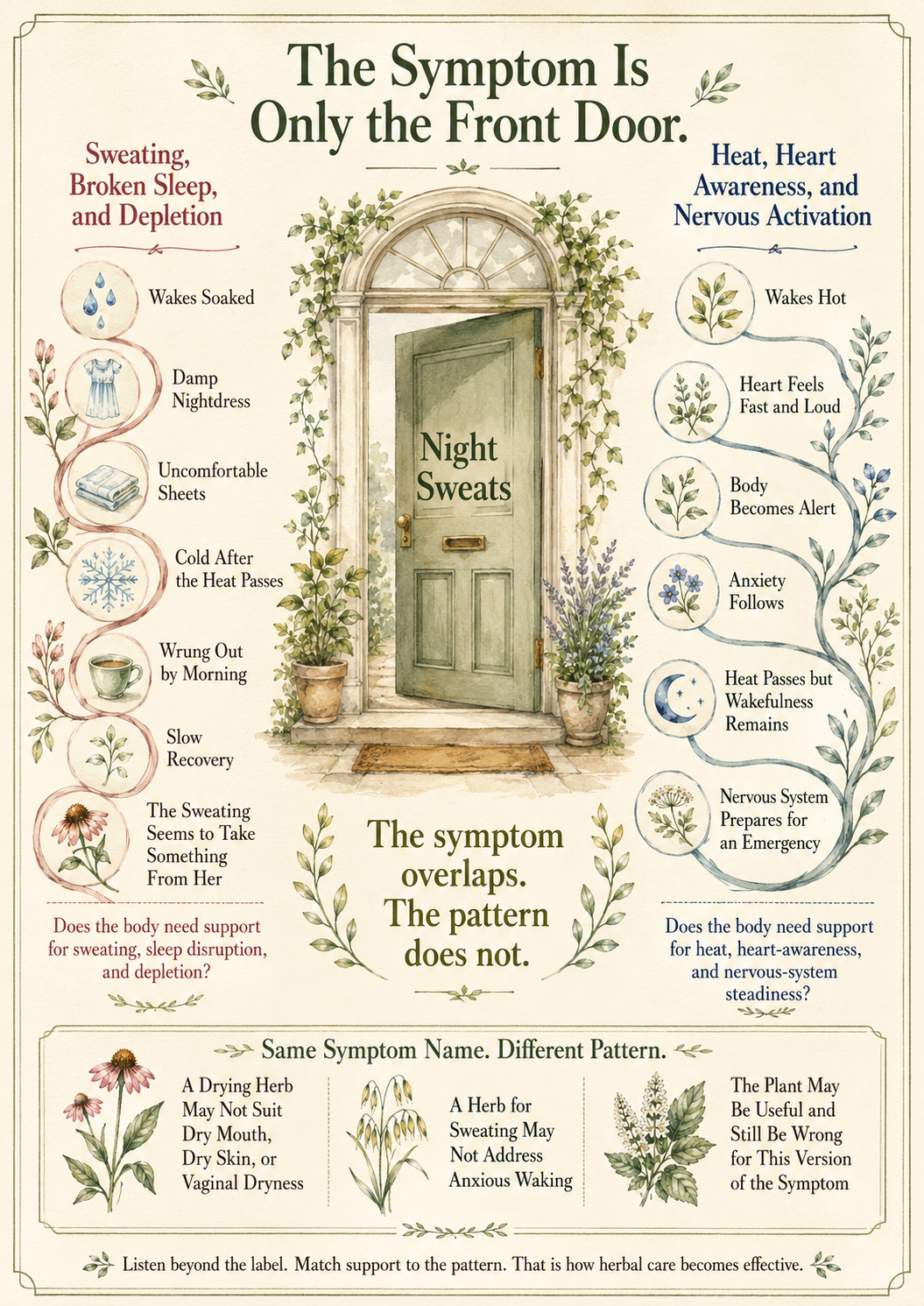
Imagine two women who both wake with night sweats.
The first wakes soaked. Her nightdress is damp, the sheets are uncomfortable, and once the heat passes she becomes cold. She feels wrung out by morning. The sweating seems to take something from her.
The second woman wakes hot too, but the first thing she notices is her heart. It feels fast and loud. Her body is alert. Anxiety follows the heat. Even after the flush passes, she stays awake. Her nervous system has prepared for an emergency that did not arrive.
Both women might say: I have night sweats.
But one pattern is centred around sweating, broken sleep, and depletion. The other is centred around heat, heart awareness, and nervous-system activation. They share the same symptom name. The useful support may look quite different.
This is why a list of herbs for night sweats can only take you so far. A herb chosen mainly for excessive sweating may not address anxious waking. A drying herb may not suit a woman who is already dry in her mouth, skin, or vaginal tissues.
The plant may be useful. It may simply be the wrong plant for this version of the symptom.
Poor Sleep Is Not One Pattern Either
Now take sleep.
I cannot sleep sounds like one problem. But what wakes you?
Heat? Sweat? Pain? A full bladder? Hunger? Anxiety? A mind replaying yesterday's conversation with improved dialogue?
These experiences all end with the same result: you are awake when you would rather not be. But they do not begin in the same place.
If heat wakes you, the first work may be understanding the heat. If bladder urgency wakes you, a stronger sleep herb may still leave you running to the toilet at two in the morning. If anxiety wakes you, a herb that simply sedates may quiet the symptom without touching what is driving it.
The symptom is poor sleep. The useful question is: what is stealing the sleep?
That question immediately gives you more information than asking what is the best sleep herb.
The Body Does Not Work in Separate Departments
Menopause is often introduced as a hormonal event. It is that, but it is not only that.
The cycle, nervous system, digestion, liver, circulation, heart, bladder, vaginal tissues, bones, joints, sleep, energy, and emotional life are all part of the same living system. They do not politely take turns.
Poor sleep may make heat harder to carry the next day. Repeated night sweats may leave the body feeling depleted. Constipation may worsen pelvic pressure and heaviness. Stress may be making heat more unpredictable. A busy, under-nourished, poorly slept body may simply have less capacity to regulate anything.
This does not mean every symptom has one grand hidden cause. It means the body gives better information when you look at the pattern, not just the label.
Instead of asking only what symptom do I have, begin asking: what seems to travel with it?
That is the small change that turns a list of complaints into a pattern.
Four Questions Before Choosing a Herb
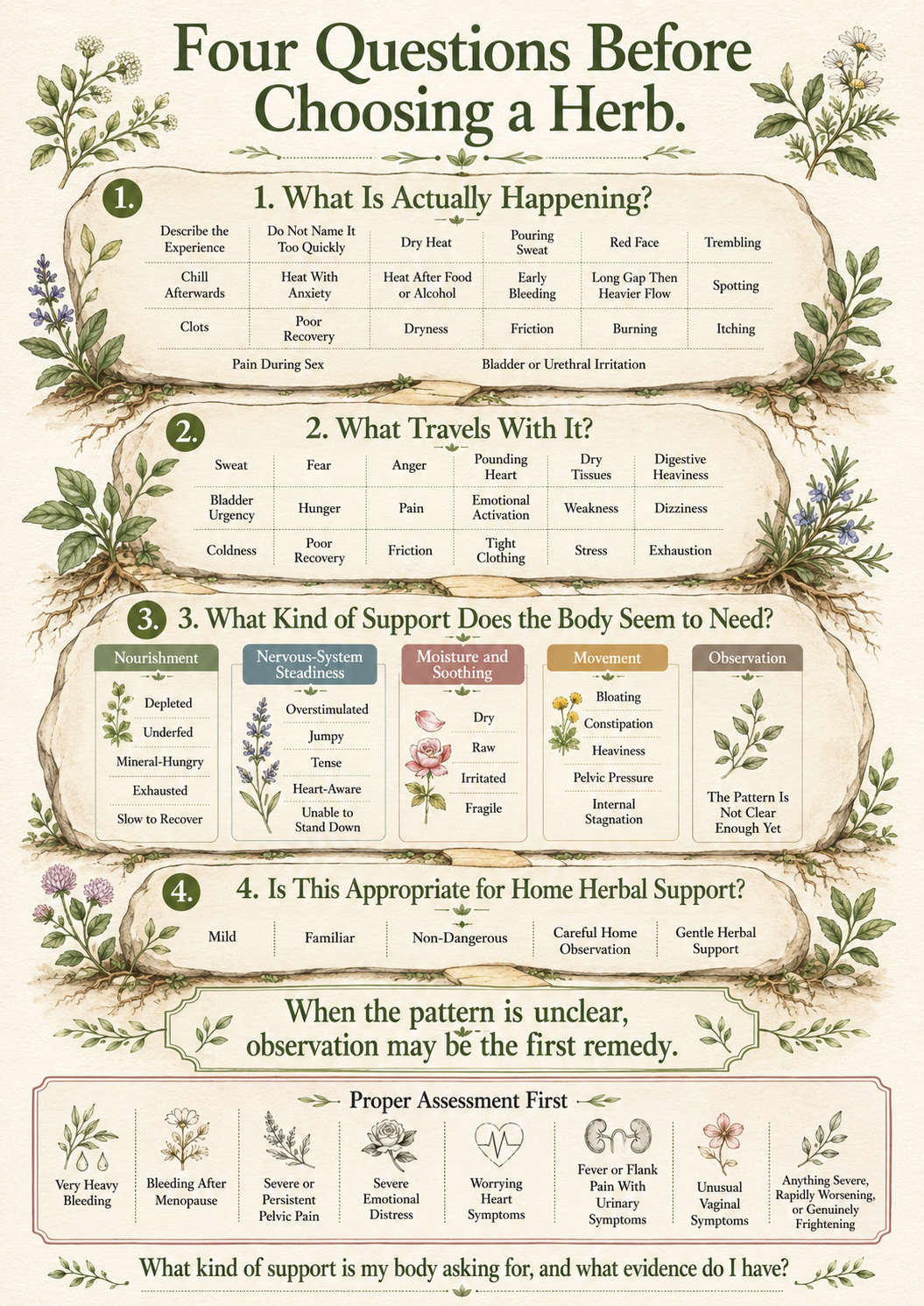
Before reaching for a herb, use these four questions. They do not give you a complete treatment plan. They give you a much clearer starting point.
What is actually happening?
Describe the experience rather than naming it too quickly.
Heat might mean dry heat, pouring sweat, a red face, trembling, a chill afterwards, heat with anxiety, heat after food or alcohol, or a wave that comes with heart awareness. These are not all the same.
Bleeding might mean a period arriving early, a long gap followed by a heavier flow, spotting, prolonged bleeding, clots, or poor recovery. These are not all the same.
Dryness might mean less lubrication, friction, burning, itchy external tissue, pain during sex, or a bladder and urethral irritation that seems vaginal in character. These are not all the same.
The more clearly you describe what is happening, the less likely you are to choose a remedy for the wrong version of the problem.
What travels with it?
Symptoms rarely arrive alone. When the main symptom appears, notice what joins it.
Does heat arrive with sweat, fear, anger, a pounding heart, dry tissues, or digestive heaviness? Does poor sleep arrive with bladder urgency, hunger, pain, or a replaying mind? Does low energy arrive with poor recovery, coldness, or emotional activation?
What travels together often needs to be considered together.
What kind of support does the body seem to need?
This is the point where herbal thinking becomes more useful than symptom matching.
The body may be asking for nourishment. It may feel depleted, underfed, mineral-hungry, exhausted, or slow to recover. Infusions, mineral-rich foods, and food-like preparations may serve it better than strong specific herbs.
The body may be asking for nervous-system steadiness. It may feel overstimulated, jumpy, tense, heart-aware, or unable to stand down. Something that nourishes the nerves and helps the body find its way back to calm may be more appropriate than a hot, stimulating, or forceful approach.
The body may be asking for moisture and soothing. Dry, raw, irritated, or fragile tissues need a different direction from a hot, wet, flooded pattern.
The body may be asking for movement. Bloating, constipation, heaviness, pelvic pressure, or a sense of internal stagnation may respond to movement, bitters, and herbs that encourage flow.
And sometimes the body is not clear enough yet. That is a valid answer too. When the pattern is unclear, observation may be the first remedy.
Is this appropriate for home herbal support?
This question is not the gloomy footnote at the end of herbal learning. It is part of the method.
Some mild, familiar, and non-dangerous patterns may be appropriate for careful home observation and gentle herbal support. Others need proper assessment first.
Very heavy bleeding, bleeding after menopause, severe or persistent pelvic pain, severe emotional distress, worrying heart symptoms, fever or flank pain with urinary symptoms, or unusual vaginal symptoms should not be managed by adding herbs while hoping for the best.
The thought it is probably menopause should never be used to silence your own concern. Knowing when not to reach for a herb is part of knowing herbs well.
Not All Herbs Are Doing the Same Job
The word herb is broad enough to hide some very important differences.
A mineral-rich infusion is not the same thing as a concentrated tincture. A food-like nourishing plant is not the same as a strong stimulant or sedative. A cooling, moistening herb is not the same as a warming, drying one. A herb that works over months is not the same as one that acts within hours.
Some herbs sit close to food and work slowly. Some gradually tone or strengthen. Some stimulate or sedate more noticeably. Some are only appropriate for short courses. Some should only be used with specific cautions in place.
This is why natural tells you almost nothing about whether a remedy fits.
The better questions are: what is this herb intended to do? In which form? For which pattern? For how long? What should I observe? When would I stop?
You do not need to answer all of these perfectly before drinking a simple cup of herbal tea. But you should know why you chose it and what you are watching for.
One Clear Experiment
Once you begin learning herbs, it becomes strangely easy to start everything at once.
A tea for sleep. A tincture for heat. A supplement for hormones. A blend for stress. Something recommended by a friend who had a completely different pattern.
Soon, you may feel different. But you have no idea why.
One clear experiment teaches you more.
Choose one main pattern, one simple foundation, one change to observe, and one safety boundary.
That might mean watching the relationship between stress and heat before adding a remedy. It might mean making the night environment cooler and tracking sleep for a week. It might mean starting one infusion, using it consistently for two to three weeks, and noticing what changes.
The plan does not need to look impressive. It needs to be clear enough that your body can answer.
Use Your Seven-Day Observation Plan
Return to the result from your Menopause Herbal Map.
Write down your main territory, your closer pattern, the one symptom or relationship that most affects daily life, and the one thing you are going to observe this week.
For the next seven days, observe one pattern. Each time it appears, record: what happened, what happened before it, what seemed to worsen or improve it, what you ate, how you slept, and how your stress level was.
At the end of the week, do not ask whether you have solved menopause. Ask: what repeated?
Perhaps heat repeatedly followed an evening glass of wine. Perhaps night waking usually began with sweating rather than with anxiety. Perhaps the pattern was so variable that nothing stood out yet.
That last result is not useless. It tells you not to rush into a complicated remedy plan yet.
Observation is not doing nothing. It is how you stop guessing.
What This Lesson Cannot Tell You
This lesson can help you recognise why symptom lists are limited. It can help you begin describing your pattern. It can help you approach herbalism a little more clearly than before.
But it cannot tell you, from one page, which specific herb best fits every version of your pattern; which preparation is most appropriate; how long to use it; what to watch for; or when something needs more than herbs.
Those decisions need more than a symptom name. They need the wider map.
A Better Question
The next time you find yourself asking what is the best herb for this, pause.
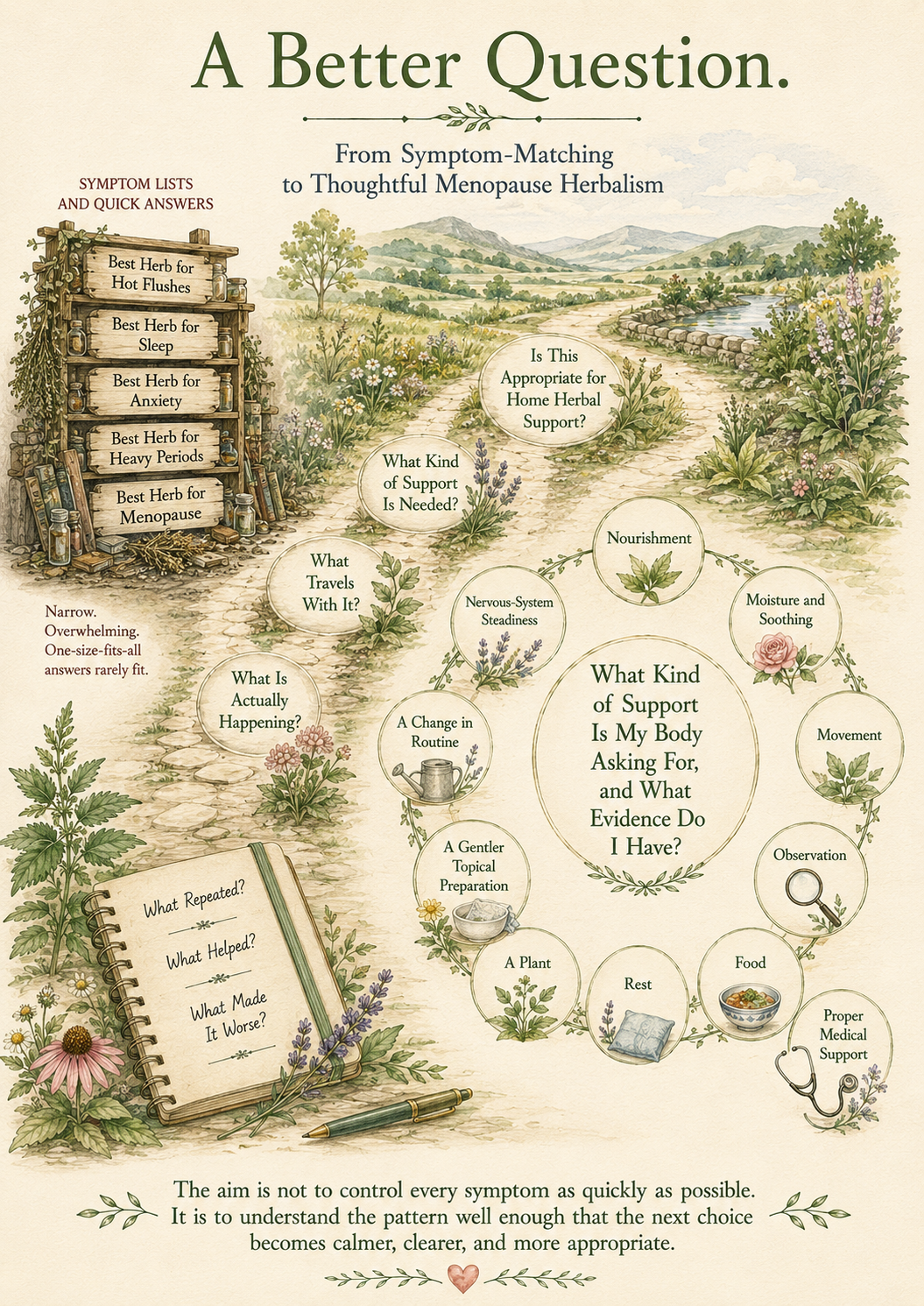
Try this instead: what kind of support is my body asking for, and what evidence do I have?
That question may lead you towards a plant. It may also lead you towards food, rest, movement, a gentler topical preparation, a simpler daily rhythm, or proper assessment.
The aim is not to control every symptom as quickly as possible. It is to understand the pattern well enough that your next choice becomes calmer, clearer, and more appropriate.
That is where good menopause herbalism begins.
Your Menopause Herbal Map has helped you find the territory. This lesson has shown you why the symptom is only the beginning of the question.
Inside the complete Green Guild Menopause Herbal Course, you will learn how to move from recognising a pattern to understanding it, from understanding it to choosing support, and from choosing support to tracking whether it is actually working.
You will explore the changing cycle, heavy bleeding and recovery, heat and night sweats, sleep and nervous-system strain, and the long postmenopausal seasons of bones, heart, bladder, and vitality.
Not as a shopping list. As a way to understand what you are choosing, why you are choosing it, and when another kind of support is what the body actually needs.
Explore the Complete Menopause Herbal CourseThe aim is not to control every symptom as quickly as possible. It is to understand the pattern well enough that the next choice becomes calmer, clearer, and more appropriate.