
Module 4 · Lesson 6
Bladder Infections and Urinary Burning
A burning bladder can make the whole body feel unsafe.
One minute you are going about your day, and the next you are planning everything around the toilet. There may be burning when you pass urine, a sharp urgency that gives you no patience at all, or the maddening feeling that you need to urinate again even though almost nothing comes out.
It can feel hot, raw, urgent, and strangely personal.
When the Body Feels Unsafe
In postmenopause, urinary symptoms deserve especially careful attention. Not panic. Not embarrassment. Just clear, calm attention. Bladder infections can be simple and short-lived, but they can also become more serious if they move upwards or are not properly dealt with. Burning can come from infection, but it can also come from irritated vulval tissue, vaginal dryness, yeast irritation, concentrated urine, or bladder sensitivity.
So the first skill is not choosing the strongest herb. The first skill is asking: what is actually happening here?
What a Bladder Infection Can Feel Like
A straightforward bladder infection often has a recognisable pattern.
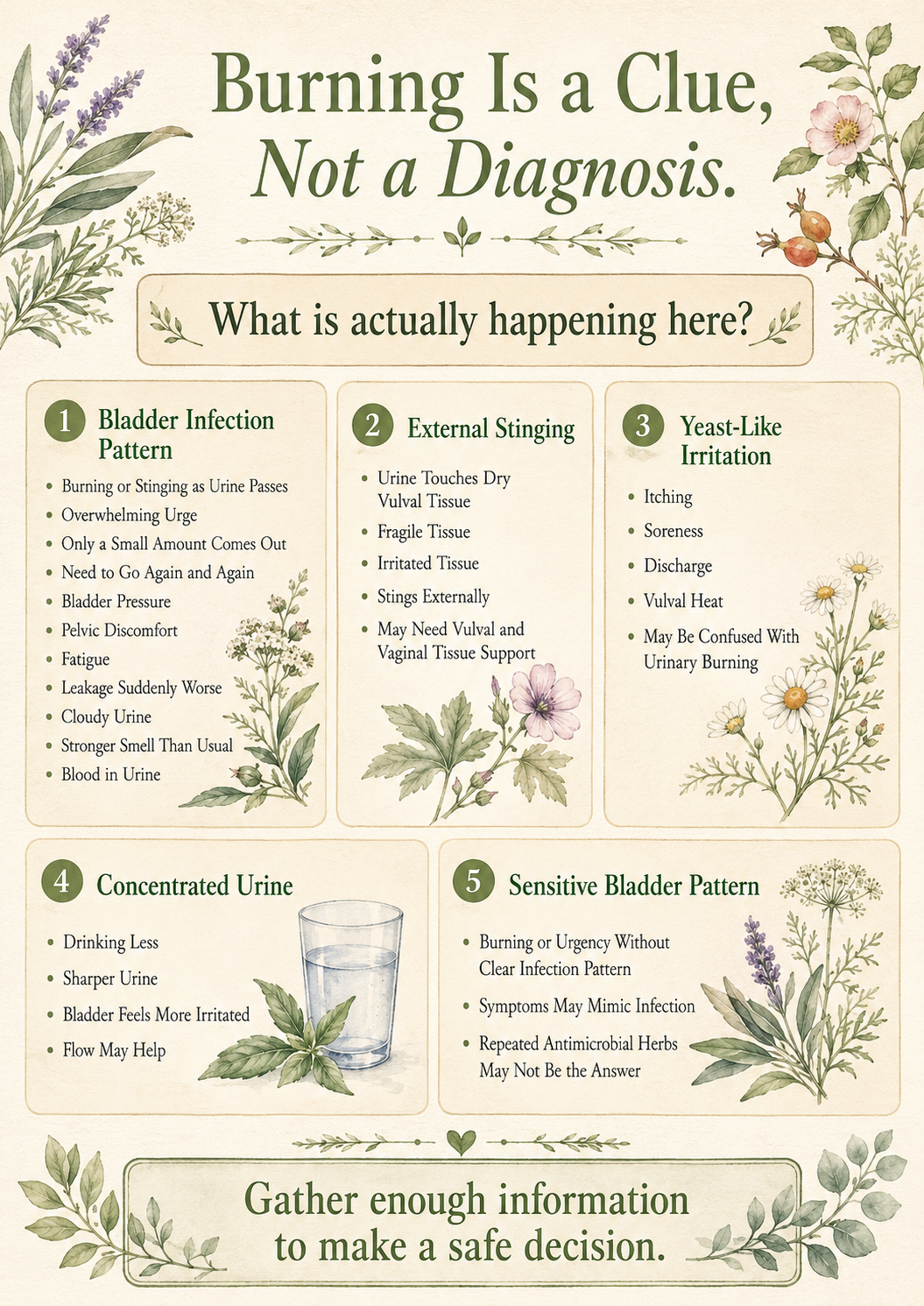
There may be burning or stinging as urine passes. You may feel an overwhelming urge to go but only pass a small amount. You may need to go again and again. There may be bladder pressure, pelvic discomfort, fatigue, or leakage that suddenly gets worse. Sometimes the urine looks cloudy, smells stronger than usual, or contains blood.
In postmenopause, urinary infections may also be quieter than expected. A woman may not always have dramatic symptoms at first, especially if she is used to living with urgency, leakage, or irritation. That is one reason it helps to know your own baseline. What is normal for your bladder? How often do you usually urinate? Do you normally wake at night? Do you usually have urgency? Do you ever burn when passing urine?
If you know the ordinary pattern, you can recognise a new pattern more quickly. A useful early warning sign is a change in character: urgency that feels different, burning that is new, frequency that suddenly increases, or leakage that appears alongside bladder discomfort.
Burning Is a Clue, Not a Diagnosis
Burning with urination often makes people think infection immediately. Sometimes that is exactly right. But it is not the only possibility.
If the vulval tissue is dry, fragile, or irritated, urine passing over the external skin can sting even when the bladder itself is not infected. If there is vaginal yeast overgrowth, soreness or itching may be confused with urinary burning. If the bladder is chronically sensitive, the symptoms may mimic infection but not behave like one. And if the urine is very concentrated because you have been drinking less, it may simply feel sharper.
So before you treat, observe.
Where is the burning: deep and internal, or external as urine touches the vulval tissue? Is there urgency and frequency? Is there pelvic pain? Is there fever, back pain, blood, or a feeling of being generally unwell? Are there vaginal symptoms too: itching, discharge, odour, soreness, or pain with sex?
This does not mean you need to diagnose yourself at home. It means you gather enough information to make a safe decision.
The First Response: Flow
At the first hint of bladder burning or urgency, one of the simplest responses is to increase fluids.
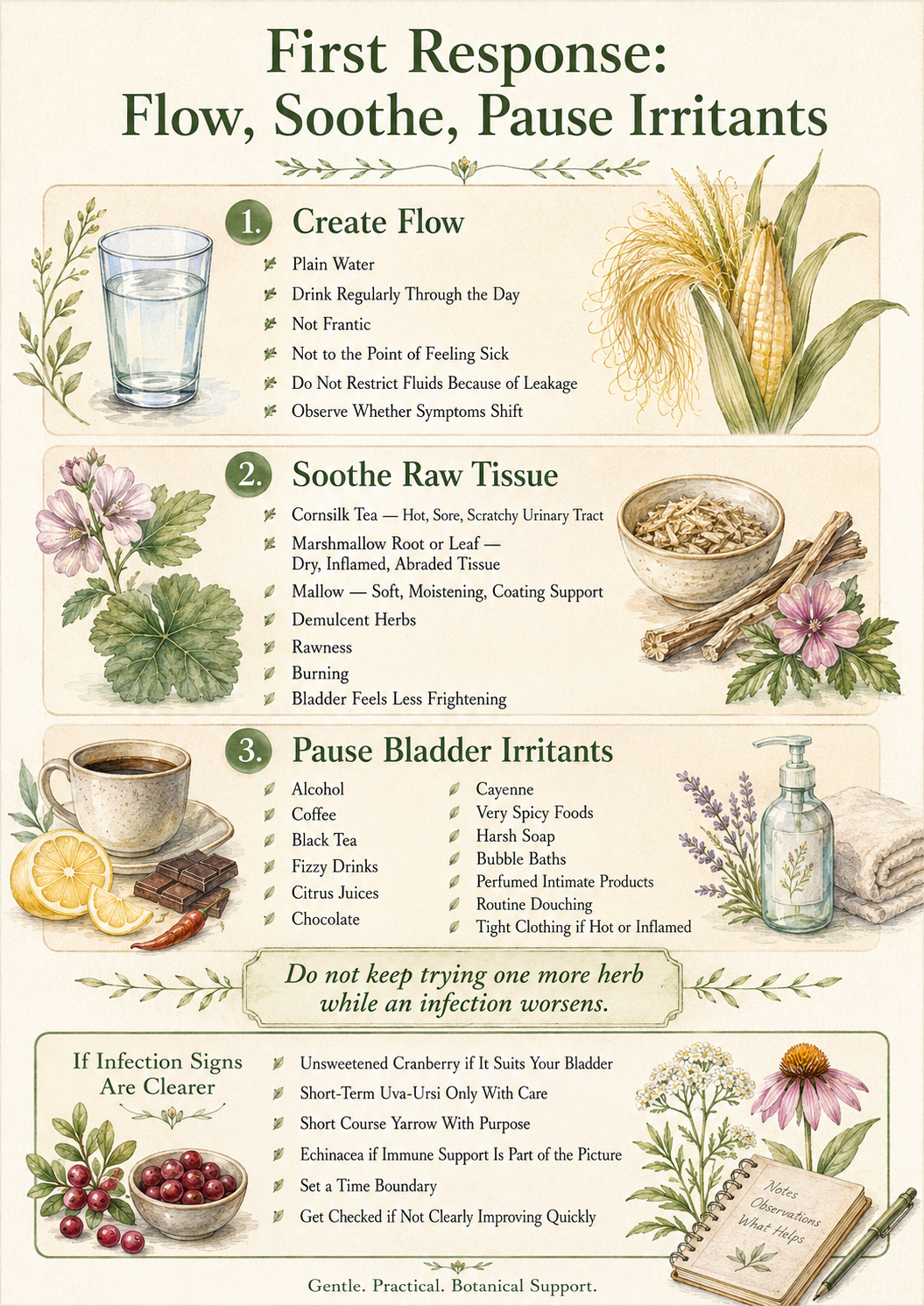
Not in a frantic way. Not to the point of feeling sick. But enough to create flow.
Think of the urinary tract as a river. When there is very little water moving through it, everything is more concentrated and irritating. When the flow increases, the system has more movement. Passing urine more often may be inconvenient, but in the early stages of bladder irritation it can be part of the support.
Plain water is the obvious choice. If you tend to restrict fluids because of leakage, this is where the body can get stuck. Leaking feels frightening, so you drink less. The urine becomes more concentrated, the bladder feels more irritated, and urgency may worsen. A bladder infection can also aggravate leakage, so under-drinking does not always protect you in the way you hope.
If you feel the first signs of burning or urgency, try drinking water regularly through the day and observe. If symptoms are mild and early, this may be enough to help the body shift. If symptoms are strong, worsening, or come with red flags, do not rely on water alone.
Cranberry: Useful, but Choose It Carefully
Cranberry is one of the best-known bladder allies, and it can be useful when chosen well.
The key is unsweetened cranberry juice or concentrate. Sweet cranberry drinks, juice blends, and sugary cocktails are not the same. Sugar can be unhelpful when infection or yeast tendencies are part of the picture, so this is one place where the label matters.
Cranberry is often used to make the bladder environment less welcoming to troublesome bacteria and to discourage them from clinging to the bladder wall. For some women, a glass daily is enough as ongoing bladder support. During acute irritation, larger amounts are sometimes used for a short time.
But cranberry does not suit everyone. If your bladder already feels sharp, acidic, or easily provoked, cranberry may irritate rather than soothe. The body gets a vote. If cranberry increases burning, stop and choose a gentler approach.
Soothing Herbs for a Raw Urinary Tract
When burning is the main symptom, do not think only in terms of killing infection. Inflamed, irritated tissue also needs soothing. This is where demulcent herbs come in.
Cornsilk, marshmallow, and mallow belong in this demulcent direction. They are useful where the urinary tract feels hot, raw, dry, scratched, or sore. We will return to this soothing approach in the next lesson, where the issue is chronic sensitivity rather than a straightforward infection pattern.
A bladder that feels less raw may spasm less, urge less, and feel less frightening.
Antimicrobial Urinary Herbs
Some herbs are used more directly when infection is part of the picture.
Uva-ursi, also known as bearberry, is a classic urinary herb. It is not a casual everyday tonic. It belongs to the short-term, specific category. It may be used as an infusion, cold infusion, tincture, or vinegar preparation, and is often paired with other herbs rather than used alone. Because it is stronger and more specific, it should be treated with respect. It is not the first herb for every bladder discomfort, especially if the problem may be chronic bladder sensitivity rather than infection. If someone has chronic bladder pain or interstitial cystitis-type symptoms, antimicrobial herbs may not be the right answer and can sometimes aggravate sensitive patterns.
Yarrow is another urinary ally. It has a disinfecting and astringent quality and may be useful when the bladder tissues feel weak, lax, or infection-prone. A small amount of yarrow infusion can be used for a short course. It is not appropriate in pregnancy, and because it is more active than a simple nourishing infusion, it should be used with purpose rather than as an endless daily tea.
Echinacea is used when immune support is needed alongside infection patterns. It is often taken more frequently in acute situations and then reduced as symptoms clear.
Nettle may be helpful as a nourishing foundation for women who are depleted, mineral-hungry, or prone to urinary weakness. Think of it as long-term nourishment rather than a rapid rescue.
What to Pause During Bladder Irritation
During urinary burning, simplify.
Pause alcohol, coffee, black tea, fizzy drinks, citrus juices, chocolate, cayenne, and very spicy foods if they seem to irritate your bladder. Not every woman reacts to all of these, but during an acute episode it is wise to make the bladder's job easier.
Also avoid irritating the urethral and vulval tissues. No harsh soap on the vulva. No bubble baths. No perfumed intimate products. No routine douching. Wear breathable underwear. Avoid tight clothing if the area feels hot or inflamed.
If symptoms began after vigorous sex, penetration, friction, or new irritation, give the tissue time to settle. Drink water. Urinate after sex if that is part of your personal prevention rhythm. Use enough lubrication if dryness is part of the pattern. Repeated infections after sex are worth discussing with a practitioner rather than managing indefinitely at home.
Getting a urine test is not a failure of herbalism. It is information. Good herbal practice is not anti-assessment. It is sensible care.