
When Dryness and Constipation Are Part of the Picture
Constipation makes people impatient in a very specific way. The bowel is not moving, and the obvious thought arrives instantly. I need something that makes it move. So out comes more force. More fibre. A stronger laxative. A bigger dose. Another supplement, ideally one promising results by morning.
And sometimes movement really is what needs support. But there is a better question sitting underneath all that force, one almost nobody asks first. Is the bowel simply slow, or is the whole picture actually dry? Because a dry, hard stool is not merely a stool running late for an appointment. It is an entirely different pattern, and by the end of this lesson you will know how to tell the two apart before reaching for anything stronger.
The person living this might describe hard stools, small dry pieces, difficulty passing them, straining, a sense that the bowel needs more softness rather than more pressure, several days between comfortable movements, bloating that builds as the stool sits there refusing to move. Sometimes broader signs of dryness show up too. A dry mouth. Dry skin. A general sense that the body simply does not hold onto moisture the way it should.
In that picture, pushing harder may miss the obvious thing sitting in plain sight. Perhaps the system does not only need movement. Perhaps it needs moisture. That is exactly where this lesson begins.
Just as IBS was never one single thing, constipation is not one single thing either. One person becomes constipated because digestion is moving slowly. Another becomes constipated specifically during stress and physical tension. Another simply is not drinking enough. Another eats too little fibre. Digestive imbalances can contribute. Certain medicines can contribute. And in an IBS picture, several of these threads often overlap at once.
This matters because constipation caused mainly by dryness is not the same animal as constipation inside a highly tense, spasmodic picture, which is not the same animal as constipation with obvious sluggishness and heaviness sitting on top of it. The stool may be equally difficult in all three. The herbal reasoning underneath still needs to differ.
Consider two people. The first says nothing seems to move, I feel heavy, full and sluggish after food. The second says I do move my bowels, but the stool is dry, hard and painful to pass. Both reach for the same word. Constipation. But the first story points hard towards slow movement. The second points hard towards dryness.
Now a third person. I become constipated when I am stressed, my abdomen tightens, I cramp, and then suddenly a few days later I get loose stools instead. Different again. Which is exactly why hearing the word constipation and immediately prescribing the same approach to everyone was never a good idea. Ask instead. Is the stool hard? Is it dry? Is movement slow? Is there tension? Is the pattern changeable? Does bloating build because the bowel simply is not emptying? Is the person drinking enough? What happens when more fibre gets added? The answers start separating one pattern from another almost immediately.
A dry bowel picture tends to involve stools that are hard, firm, sparse, pellet-like, difficult to pass, uncomfortable or genuinely painful to move. The person may feel the stool needs softening rather than simply pushing, and that distinction matters more than it sounds.
Picture trying to move something dry and compacted through a narrow passage. More force is one strategy. Adding moisture is an entirely different one. In herbal energetics, a dry state generally points towards a gently opposing direction: moisten, soothe, rehydrate. None of this is mysterious. It is simply a practical way of reading what the tissue is actually telling you. Dryness suggests moisture, the way cold suggests warmth.
Here is the equally important other half of that point. Do not assume every constipated person is dry. Suppose someone goes several days without a bowel movement, but the stools themselves are not especially dry. Instead they say my digestion is cold, heavy and slow. That may need more emphasis on movement, not moisture. Or: I am incredibly tense, I feel the urge, but everything seems to clamp down. That pulls us back towards relaxation and spasm entirely. Or: I alternate between constipation and diarrhoea. Now an aggressively moistening or laxative approach may be poorly matched to a picture that will not sit still. Use the word dryness only when dryness is actually present in front of you. Not simply because constipation showed up on the same day.
Fibre is usually the first thing anyone hears about constipation, and it absolutely can help. But an IBS student needs a more careful version of that story, because you are constipated, eat more fibre is not always enough on its own.
Fibre can improve stool consistency and support bowel movement. It adds bulk. Some forms hold water. Fibre-rich foods interact with the gut microbiome as well. And the guidance in this course allows for slowly increasing fibre from food or supplements such as flax or psyllium, when appropriate. But there is a catch. Actually, several catches.
Picture someone whose bowel is already slow, dry, inadequately hydrated. They suddenly add a large dose of fibre powder. What happens? Sometimes, genuine improvement. But sometimes more bloating, more discomfort, more backing up than before, especially when fibre arrives too quickly or without enough fluid alongside it.
Fibre is not a tiny team of plumbers entering the bowel to clear the pipes out of professional pride. It physically changes the contents of the digestive tract, and it needs context to do that safely. Add more material to a slow, dry system without enough moisture, and the result can be worse, not better. Which gives us the better rule. Fibre and hydration belong in the same conversation, always, never separately.
If hard, dry stools are part of the picture, ask the almost insultingly basic question first. Am I actually taking in enough fluid? Dehydration can aggravate constipation on its own, and once supplemental fibre enters the picture, fluid becomes even more important, not less. A fibre powder taken with inadequate water is a poor experiment from the start. So rather than thinking fibre on its own, think fibre plus adequate fluid plus gradual introduction. All three belong together, especially in IBS.
A person with IBS usually has a more reactive digestive system than most, and yet decides to become healthier on Monday morning, all at once. Breakfast now contains a large spoonful of psyllium, ground flax, chia, extra bran, a probiotic, and a fermented food, all stacked on top of each other. By Tuesday afternoon their abdomen resembles a weather balloon.
This does not prove every one of those foods is secretly harmful. It proves the digestive system was handed a genuinely dramatic amount of new work overnight. When fibre intake rises, temporary changes can include more gas, more bloating, more frequent stools, looser stools. For most people, gradual introduction is simply easier to live with, which gives us a properly important IBS principle. Do not confuse a theoretically sensible direction with a sensible starting dose. The two are not the same decision.
Small. Then observe. That is the entire glamorous secret. Instead of jumping straight to a full serving of supplemental fibre, begin modestly and increase gradually. The exact amount depends on the product and preparation, but the principle matters more than any heroic dose ever could. With a powdered fibre such as flax or psyllium, start with a very small amount rather than diving straight into a full spoonful.
Then watch. Stool consistency. Bloating. Gas. Comfort. Bowel frequency. If the body tolerates it, increase gradually from there. If symptoms worsen significantly, reassess rather than push through. Do not assume you must keep escalating because my body needs to get used to it. Sometimes slower introduction genuinely helps. Sometimes the particular fibre simply does not suit the picture in front of you. Those are two different possibilities, and it pays to tell them apart.
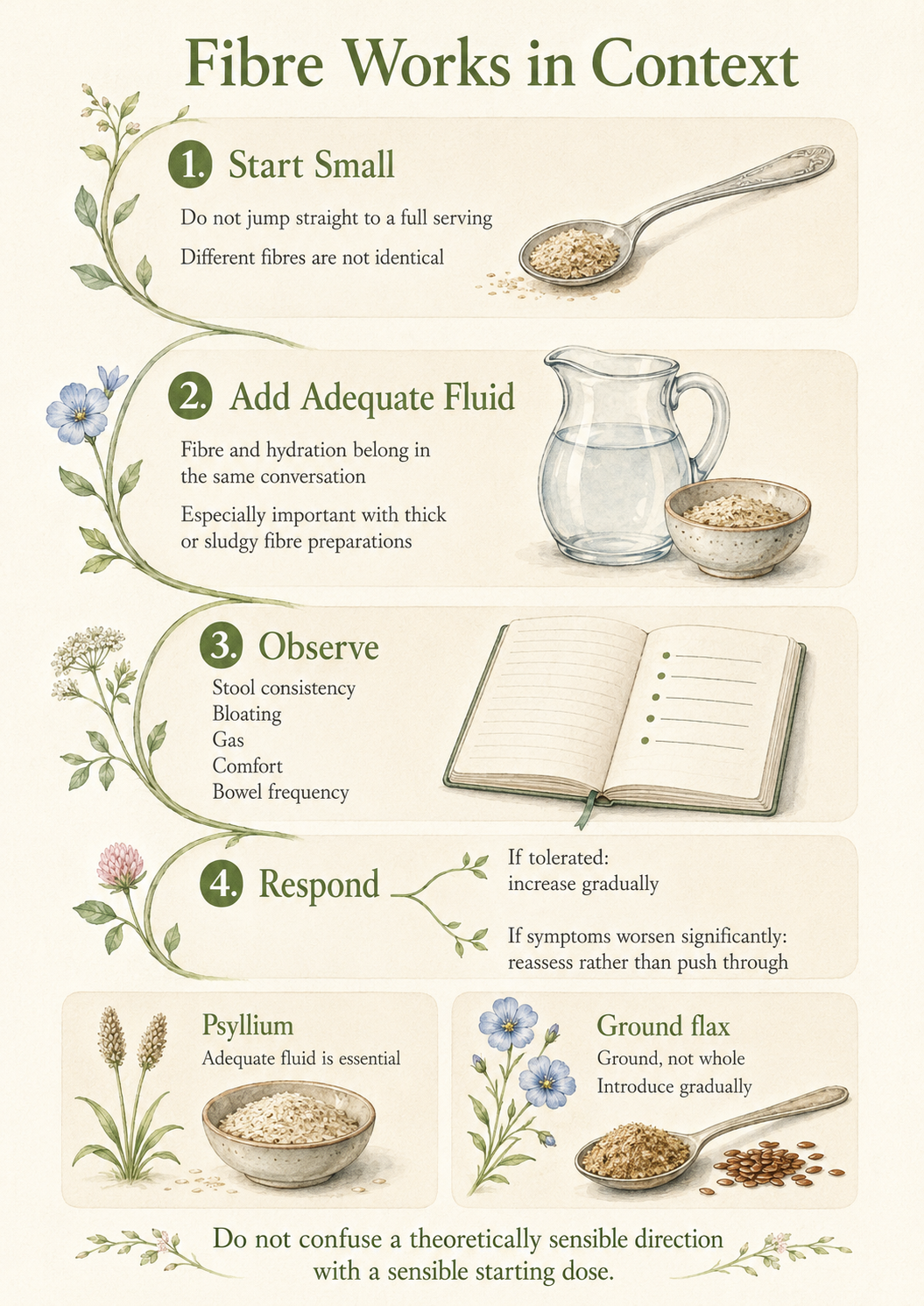
Psyllium is one fibre option worth knowing properly. It is widely available and genuinely useful in bowel regulation, and one of its more interesting qualities is helping at both ends of the stool-consistency spectrum rather than behaving like a simple, aggressive laxative. For a constipated student, its relevance lies partly in how fibre can create a softer, bulkier stool once introduced appropriately.
But there is a practical rule that cannot be skipped. Take supplemental fibre with adequate fluid, always, especially with materials that turn thick or sludgy in water. Plenty of dry fibre without enough fluid alongside it can worsen constipation, and in a more serious situation, contribute to obstruction. This is not a case where more powder simply equals more benefit, regardless of the water sitting next to it.
Ground flax is another useful possibility, and the important word there is ground. Whole flax seeds can pass straight through without offering the same benefit at all. Ground flax contributes fibre while carrying a softer, somewhat mucilaginous quality once it meets water. For some people with IBS, flax is better tolerated than more aggressive attempts to raise fibre elsewhere.
But the same rule applies again. Start gradually. Observe. Store ground flax properly, since the oils inside it can deteriorate. And do not assume that because flax is healthy, everyone should immediately take large amounts of it. Your gut still gets a vote in that decision.
At this point you might reasonably be wondering, is not this supposed to be a herbal course? Quite right. Fibre is only one part of the dry picture, and once dryness is clearly present, a different herbal action becomes genuinely interesting. Demulcent. One of the most useful categories going for a dry digestive state.
Demulcent herbs carry a soothing, moistening quality. When extracted in water, some develop a noticeably slippery texture. Others are less obviously slimy but still carry a soft, velvety character. The quality comes from mucilage, and for the digestive tract that matters because demulcent herbs can be useful wherever tissue is dry, irritated or sensitive. The single most relevant point for this course is simple. When dryness is part of the bowel picture, a moistening herb may make more sense than another strongly drying or stimulating remedy.
The star of this lesson is marshmallow.
Marshmallow
Althaea officinalis
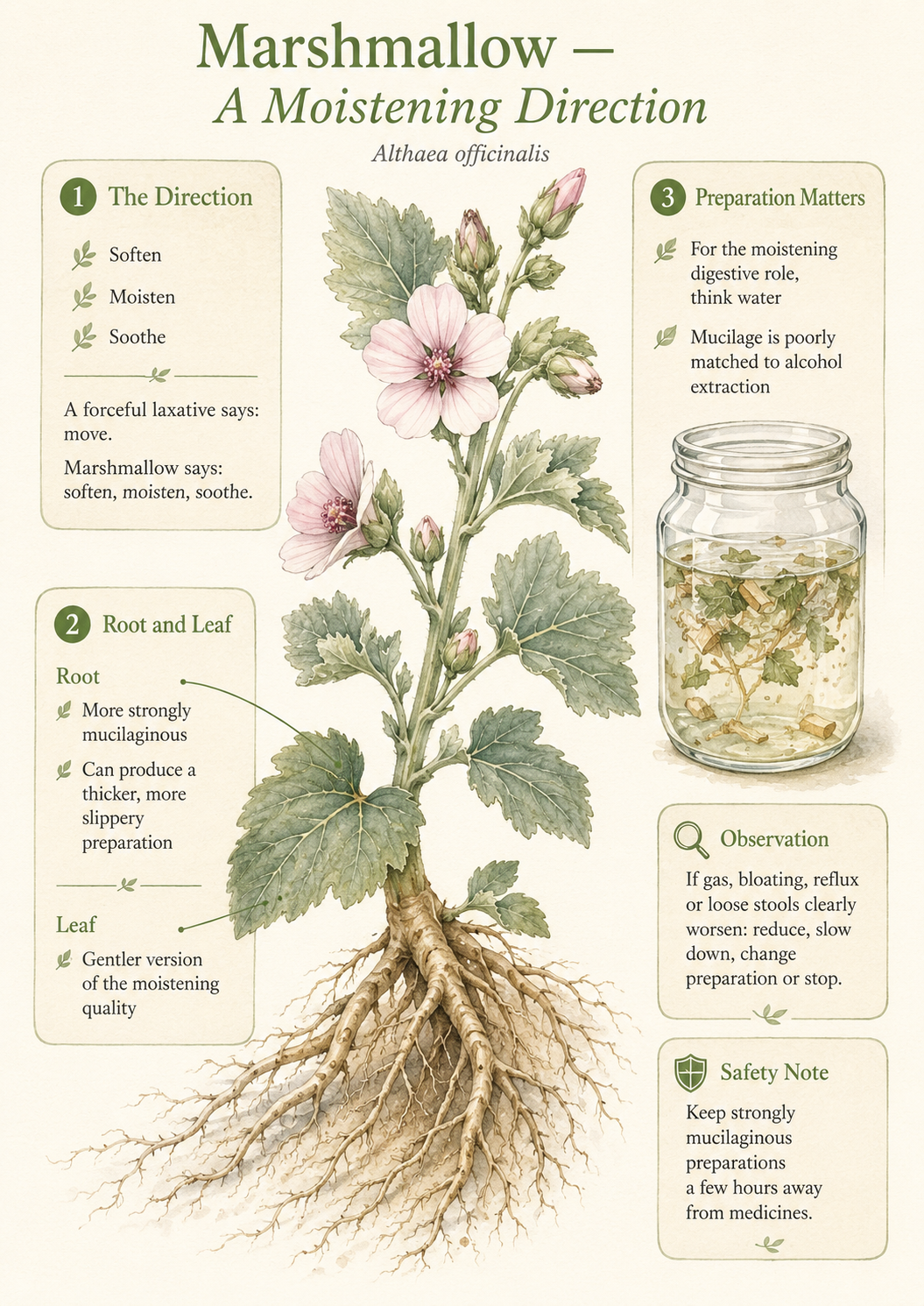
The confection borrowed the name. The plant came first, and it remains one of the clearest examples of a moistening, mucilaginous digestive herb available. Its profile runs demulcent, mucilaginous, soothing, moistening, cooling. The root is commonly sold. The leaf works too. Together they give us a particularly valuable plant for a dry, constipated IBS picture, not because marshmallow is a stimulant laxative. It is not. Its whole logic runs differently.
Here is perhaps the easiest way to understand it. A forceful laxative says move. Marshmallow says something closer to soften, moisten, soothe. An entirely different strategy. Picture someone whose stools are dry, hard, difficult to pass, whose instinct is to keep reaching for stronger and stronger substances that force action through sheer will. If dryness sits at the centre of that picture, a moistening direction deserves real consideration instead. This is exactly where marshmallow becomes coherent rather than incidental.
Consider Elena. Her IBS runs mainly constipated. Her stools are hard, dry, difficult to pass. She does not describe dramatic loose stool episodes. She is not mainly complaining of severe reflux. Her abdomen bloats when several days pass without a comfortable movement, and she puts it simply: it feels as though everything is too dry. That is a fairly clear reason to consider marshmallow, not because IBS equals marshmallow, but because dryness plus hard stool plus difficult passage creates a genuinely sensible match for a moistening demulcent direction.
Real patterns overlap, though. Suppose Elena also says when I am stressed, I tighten up completely. Now we have dryness, constipation and tension all at once, which may call for more than marshmallow alone. Perhaps the formula eventually pairs a moistening herb with a relaxing one, marshmallow sitting alongside one of the gentler herbs from Lesson 5. The logic here is not use more herbs for the sake of it. It is that two distinct jobs are visible in the same person. One job is moisten. The other is relax. That is how thoughtful formulas actually begin.
Root and leaf are not quite the same experience, even from the same plant. The root runs more strongly mucilaginous, and depending on preparation can produce a distinctly thick, slippery liquid. The leaf offers a gentler version of the same moistening quality. That difference can matter enormously in a sensitive IBS gut.
Suppose a strong root preparation produces more gas, more bloating, reflux, loose stools, a general flare in symptoms. That does not mean all marshmallow is impossible forever. It means you have options. Reduce the amount. Introduce it more gradually. Try the gentler leaf instead. Stop entirely if it keeps disagreeing. The body’s response is part of the assessment, not an inconvenient interruption to it.
This catches people by surprise every time. Marshmallow sounds gentle, and often it is. But mucilage does not simply vanish the moment you swallow it. It interacts with the whole digestive environment, feeds gut flora, and in some people, particularly with certain microbiome imbalances, stronger mucilaginous preparations can increase fermentation and aggravate gas, bloating, reflux, stool changes.
Which means the correct response to worsening symptoms is never automatically great, the herb must be detoxing me. No. Perhaps the dose is too high. Perhaps the introduction was too fast. Perhaps root is simply too much and leaf would be gentler. Perhaps marshmallow is not the right choice at this particular stage. None of that is failure. It is information, exactly the kind this course keeps asking you to collect.
A teaspoon of marshmallow tincture is not equivalent to a marshmallow infusion, and the reason is straightforward. The soothing mucilage we actually want loves water. Alcohol is poor at extracting it. So if the goal is moistening, soothing, mucilage, a water-based preparation is generally the far more logical choice. This is one of those moments where the preparation genuinely is part of the medicine, and the same plant in a different form can emphasise an entirely different quality. We make this properly practical in Lesson 11. For now, remember one line. For marshmallow’s moistening digestive role, think water.
One important caution deserves its own space. Thick mucilage can slow or reduce the absorption of substances taken alongside it, which matters particularly with medication. The concern is greatest with more concentrated forms, powders, very thick preparations. Gentler leafy teas raise less concern. But as a practical rule, keep strongly mucilaginous preparations a few hours away from medicines rather than swallowing them together in the same sitting. A good example of why gentle herb never means no practical considerations. Marshmallow may be one of the friendlier herbs in the whole course. It still deserves intelligent use.
There is a part of constipation no herb can fully compensate for. Ignoring the urge. Perhaps you are at work, travelling, busy, and the toilet is simply inconvenient, so you postpone. Then postpone again. Over time, repeatedly delaying bowel movements can interfere with the body’s normal signals and movement entirely.
This is not about blaming anyone. Modern life is astonishingly skilled at scheduling meetings for the exact moment the bowel has finally developed an opinion. But where possible, respond to the urge rather than repeatedly training yourself to ignore it. Basic. It still matters enormously.
Sometimes constipation carries a tension component nobody mentions out loud. The person sits on the toilet thinking come on, then strains harder. Jaw tight. Shoulders tight. Pelvic muscles tight. The entire body apparently united in one campaign of frustration. More force rarely helps here.
A more relaxed approach can help instead. Give yourself time when the urge arrives. Breathe rather than brace. Use a small footstool to bring the body closer to a natural squatting position. Consider gentle abdominal massage. Reduce unnecessary tension wherever you notice it building. None of this replaces treatment for persistent constipation. It simply acknowledges that elimination is a physical process involving movement and muscular coordination, and for some people with IBS, tension is still part of the picture even when dryness dominates the surface story.
The digestive tract does not exist separately from the rest of the body. Standing, walking, gentle movement, all of it can support motility, which matters especially for someone who spends long periods sitting and feels sluggish, backed up, heavy. Not a miracle cure, none of this. But the point of a genuinely practical herbal course is never to pretend herbs must do every job alone. Sometimes the most sensible plan is adequate fluid, gradual fibre, movement, attention to the urge, and one well-chosen herb, rather than a seven-bottle protocol assembled in a panic.
You already know bitters can encourage digestive activity and motility, so yes, in some constipation pictures they are genuinely relevant. But this lesson is specifically about the dry pattern, and that distinction matters here more than usual.
Suppose someone is dry, irritated, sensitive. A strong bitter is probably not the first move. Or suppose the gut turns painful or burns with bitters. Listen to that. The answer is never I need more because they are working. Perhaps the current tissue state simply needs a gentler approach instead. In another person with obvious sluggishness, poor movement, no clear irritation, bitters may deserve considerably more attention. Which is why we keep returning to pattern, lesson after lesson, rather than settling on a favourite herb.
This sounds obvious once stated, and it is still easy to miss in practice. Some herbs carry genuinely drying qualities. Astringents, which we meet in the next lesson, are a good example. They help when the bowel is loose or lacking tone. But in a person already producing dry, hard, difficult stools, a strongly drying approach can worsen the whole picture.
One of the simplest uses of energetics in this entire course. Already dry? Be cautious about adding more dryness. The aim was never to make every herb moistening. It is to avoid blindly pushing an existing imbalance further in the same direction.
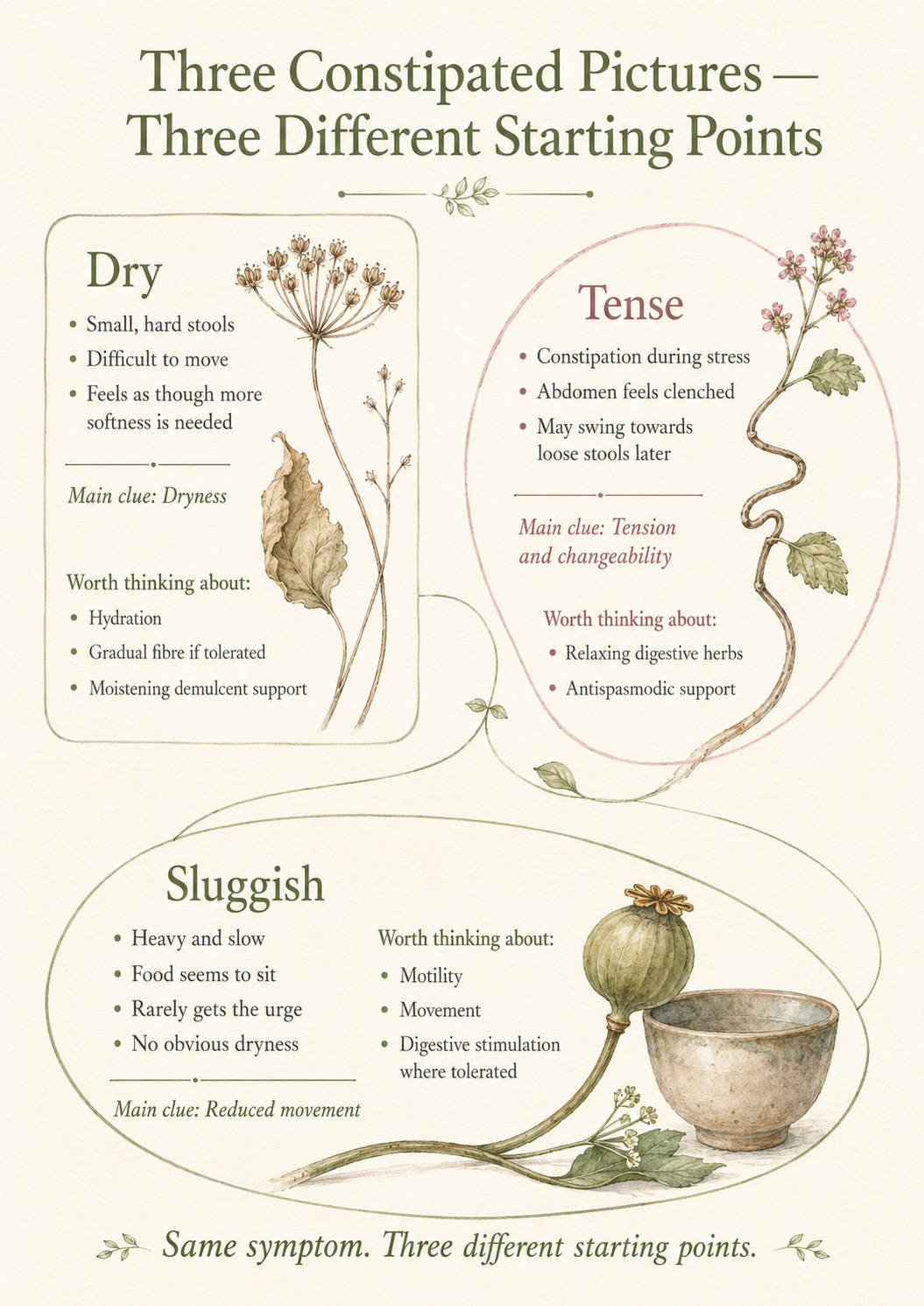
Compare three constipated pictures side by side.
• Person A, dry: I pass small, hard stools, they are difficult to move, I feel as though I need more softness. Main clue: dryness. Worth thinking about hydration, gradual fibre if tolerated, moistening demulcent support.
• Person B, tense: I become constipated when stressed, my abdomen feels clenched, I often swing towards loose stools later. Main clue: tension and changeability. Worth thinking back to relaxing digestive herbs and antispasmodic support.
• Person C, sluggish: I feel heavy and slow, food sits, I rarely get the urge, there is no obvious dryness. Main clue: reduced movement. Worth thinking about motility, digestive stimulation where tolerated, movement, the wider sluggish pattern.
Same symptom. Constipation, on all three charts. Three genuinely different starting points underneath it.
Common enough to deserve its own question. Someone sees bloating and assumes I need to avoid anything moistening. Not necessarily true at all. If bloating builds because stools are hard, bowel movements are infrequent, the whole system is dry and backed up, then resolving the dry constipation picture may matter more than simply chasing the gas directly.
Caution still applies, though. Introduce large amounts of fibre, marshmallow root powder, or other fermentable material, and if bloating explodes, slow down. Use less. Try a gentler preparation. Perhaps fennel belongs alongside the fibre. Perhaps the whole assumption needs reassessing from scratch. The pattern tells you where to begin. The response tells you what happens next.
Do not panic, and do not automatically declare all fibre your enemy for life. Ask instead.
• Did I add too much too quickly? Very common.
• Did I take enough water with it? Genuinely important.
• Which fibre did I actually use? Different materials are not identical to one another.
• Was I already severely constipated beforehand? Adding more bulk to a badly backed-up system can be uncomfortable regardless of the fibre’s quality.
• Did the change produce mild temporary gas, or major worsening? Not the same thing at all.
• Does the reaction repeat? Useful information every time it does.
Later, in the microbiome lesson, we examine why products marketed as gut healthy can sometimes make an IBS gut feel dramatically worse. For now: go slowly enough to actually learn something.
Use the same method if marshmallow makes you worse.
• Was the dose large?
• Was it root powder specifically?
• Did I introduce it suddenly?
• Would a gentler leaf preparation make more sense here?
• Did it clearly increase gas, bloating, reflux or loose stools?
Then respond accordingly. Reduce. Slow down. Change preparation. Stop entirely if needed. The herb does not get to overrule your own experience simply because the textbook category says soothing. Your body remains part of the assessment, always.
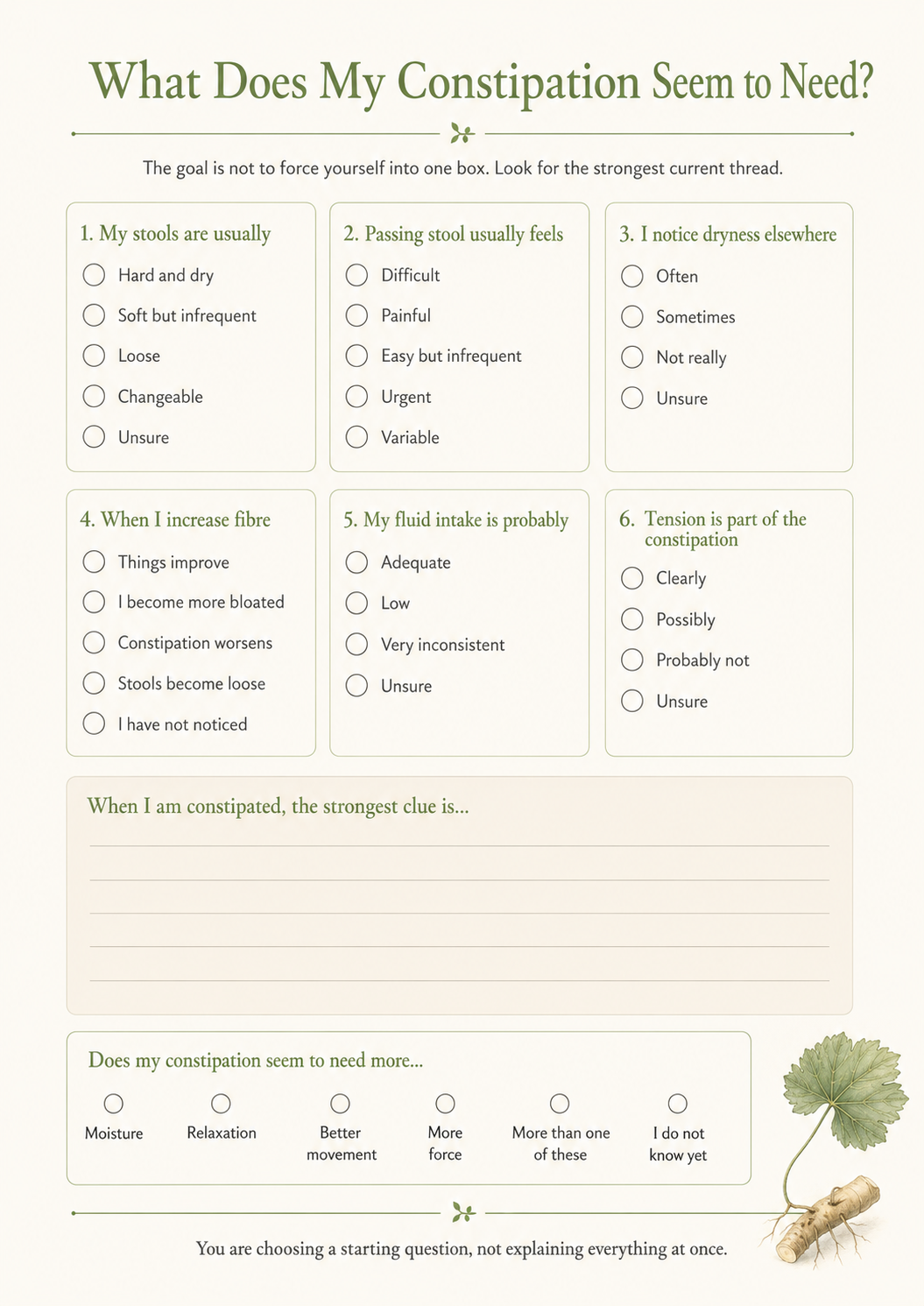
Look at your own pattern and answer honestly.
• My stools are usually hard and dry, soft but infrequent, loose, changeable, or unsure.
• Passing stool usually feels difficult, painful, easy but infrequent, urgent, or variable.
• I notice dryness elsewhere often, sometimes, not really, or unsure.
• When I increase fibre, things improve, I become more bloated, constipation worsens, stools become loose, or I have not noticed.
• My fluid intake is probably adequate, probably low, very inconsistent, or unsure.
• Tension is part of the constipation clearly, possibly, probably not, or unsure.
None of this diagnoses a dry state on its own. It helps you see whether dryness deserves a genuine place in your picture.
Now compare four broad scenarios.
• Hard, dry stools plus difficult passage: consider moisture first, marshmallow becomes relevant, gradual fibre and adequate fluid may matter too.
• Hard stools plus obvious stress and gripping: consider moisture plus relaxation, perhaps a demulcent direction alongside a relaxing digestive herb.
• Constipation plus cold heaviness plus slow digestion: consider that movement may need more emphasis than moisture, a genuinely different strategy from simple dryness.
• Constipation alternating with loose stools: be cautious about pushing hard in either direction, the changeable pattern may need a more regulating, tension-aware approach altogether.
No single herb gets crowned here. That has been the point all along.
The wider herbal world contains many plants with soothing or mucilaginous qualities, so why focus this whole lesson on one? Because this is a mini-course, and a mini-course gets worse, not better, every time a useful sentence gets followed by here are nine more herbs to remember.
Marshmallow gives us a clear way to understand demulcent action, mucilage, moistening support, preparation choice, gradual introduction, medication-spacing considerations, individual tolerance, all in one plant, studied properly. That is enough depth to be genuinely useful. A small herb roster understood well beats a catalogue remembered badly, every single time.
Finish this sentence. When I am constipated, the strongest clue is. The stool is very dry, perhaps. Or: I feel tense and cannot relax. Or: my whole digestion is slow. Or: I become bloated. Or: I alternate with loose stools. Or, honestly: I do not yet know.
Now ask: does my constipation seem to need more force, more moisture, more relaxation, or better movement? You may choose more than one. That is perfectly fine. But try to name the strongest thread running through it.
 Download worksheet
Constipation was never automatically take a stronger laxative, and it was never automatically add as much fibre as possible either. In IBS, the constipated picture may involve dryness, tension, slow movement, inadequate fluid, insufficient fibre, or some mixture of all five. When the pattern is clearly dry, the herbal direction changes entirely.
Fibre may help, introduced gradually and with adequate fluid. Psyllium can be a genuinely useful supplemental fibre, but water is essential alongside it. Ground flax offers another fibre option, suiting some people well when introduced slowly. Marshmallow becomes particularly relevant when stools are hard and dryness is part of the picture, because its direction runs moistening, soothing and demulcent rather than forcefully stimulating.
But even marshmallow needs judgement. Strong mucilaginous preparations can increase gas, worsen bloating, aggravate reflux, alter stools in some people, and can interfere with medicine absorption, particularly in concentrated forms. So the method stays exactly what it has been all course. Start small. Observe. Adjust. And above all, do not treat every constipated bowel as though it simply needs to be pushed harder. Sometimes the more intelligent question is: is this gut asking for movement, or is it asking for moisture?
In the next lesson we move to the opposite end of the bowel pattern entirely. Loose stools. Urgency. A sense that things are moving too quickly, or simply lack firmness. And there we meet a very different herbal action, astringency, alongside one of the most familiar kitchen spices in the whole course, cinnamon. But just as moistening was never automatically right for every constipated person, a drying and toning herb is not automatically right for every loose stool either.