How Hyssop Cuts Through Coughs, Congestion, and Shame
- Roland Koronya


We have a tendency to think that modern science and ancient tradition speak two different languages. But every so often, you stumble upon a plant like Hyssop (Hyssopus officinalis), and you realize that the ancients were noticing patterns long before we had the clinical vocabulary to describe them.
When King David wrote in Psalm 51:7, “Purge me with Hyssop, so that I shall be clean. Wash me so I may be as white as snow,” he wasn’t just reaching for a poetic metaphor. He was identifying a biological outlier—a plant with a “protective-like quality” and a staggering affinity for nearly every system in the human body.
For the beginner looking for the perfect herb to get to know, Hyssop is a “tipping point” plant: it is vibrant, easy to grow, and packed with medicinal indications.
The Profile of an Aromatic Bitter
In the world of the Lamiaceae (Mint) family, plants usually specialize. Lemon Balm (Melissa officinalis) and Peppermint (Mentha × piperita) are strictly aromatic. On the other end of the spectrum, Motherwort (Leonurus cardiaca) is a “straight bitter”.
But Hyssop is a unique outlier because it is an aromatic bitter. It tastes pungent, aromatic, and bitter all at once. This isn’t just a culinary curiosity; it’s a functional strategy. Its pungency creates a “hot” feel that signals its warming effect on your circulation. Depending on the individual crop yield and the season, the intensity of these tastes might shift, but the underlying mechanics of the plant remain the same.
The Multi-System Affinity
If you look at the “Materia Medica” of Hyssop, you see a plant with a staggering list of affinities that touch nearly every part of the human anatomy:
- Digestion: It stimulates secretions from the gastrointestinal tract and increases blood flow to the gut.
- Respiration: It soothes the throat and opens the bronchial passages and lungs.
- The “Febrile Mechanism”: It influences the entire physiological process of how the body works with a fever.
- The Cardiovascular System: As a pungent herb, it increases circulation.
- Liver & Kidneys: It has been used for liver stagnation and jaundice, and it promotes diuresis, influencing the urinary tract.
- Female Reproductive: Its warming, circulatory stimulant properties can be helpful for cases of amenorrhea.
While its historical accounts cover almost every organ system, its “core” affinities—where its actions truly shine—are digestion and respiration.
The Mechanics of the "Baked Down" Cough
The 19th-century King’s Dispensatory described Hyssop as a stimulant, carminative, and tonic, particularly useful as a gargle for sore throats when combined with Sage and alum. But let’s look at the “how” of its respiratory genius.
When excess heat in the tissues causes mucus to “bake down,” it adheres to the respiratory tissues, making it nearly impossible to cough out. Hyssop performs a sophisticated two-step maneuver to solve this:
- Its volatile oils penetrate the mucus, breaking it up to make it easier to expel.
- Its bitter action increases secretions in the lungs to moisten dry tissues.
These fresh secretions introduce antibodies and immunological factors to the area, helping the body fight infection. Furthermore, it acts as a spasmolytic, relaxing tension in the bronchioles for asthmatic, wheezing, or irritable spasmodic coughs.
The Fever Paradox and Energetics
It seems counterintuitive to use a “warming” herb like Hyssop to treat a fever. But Hyssop is a classic fever remedy because it stimulates diaphoresis—driving heat from the core out to the periphery through sweat. Historically, it was a staple for conditions like scarlet fever and measles. In a modern context, it is particularly indicated for the “lingering dry cough” many experienced following a COVID infection.
The energetics of Hyssop are a fascinating study in contrast:
- It is a net-warming plant and a stimulant.
- It has a short-term moistening effect because its bitters induce secretions.
- However, it is long-term drying because it ultimately drains fluids from the body.
In Ayurvedic terms, Hyssop decreases Vata and Kapha while elevating Pitta. Because Pitta runs hot, Hyssop is not recommended for them. However, for the cold/depression tissue state—characterized by hypoactivity and low vitality—Hyssop’s warming and stimulating properties are exactly what is needed to balance the system.
The Psychological and Spiritual Blueprint
The practitioner David Dalton notes that Hyssop’s “cleansing” isn’t just physical. It is for the person who struggles with internalized shame and feels “unclean,” perhaps fearing punishment from God or others. Combined with its biblical history, Hyssop offers an overall cleaning effect on the body, mind, and soul.
Cultivation and Preparation
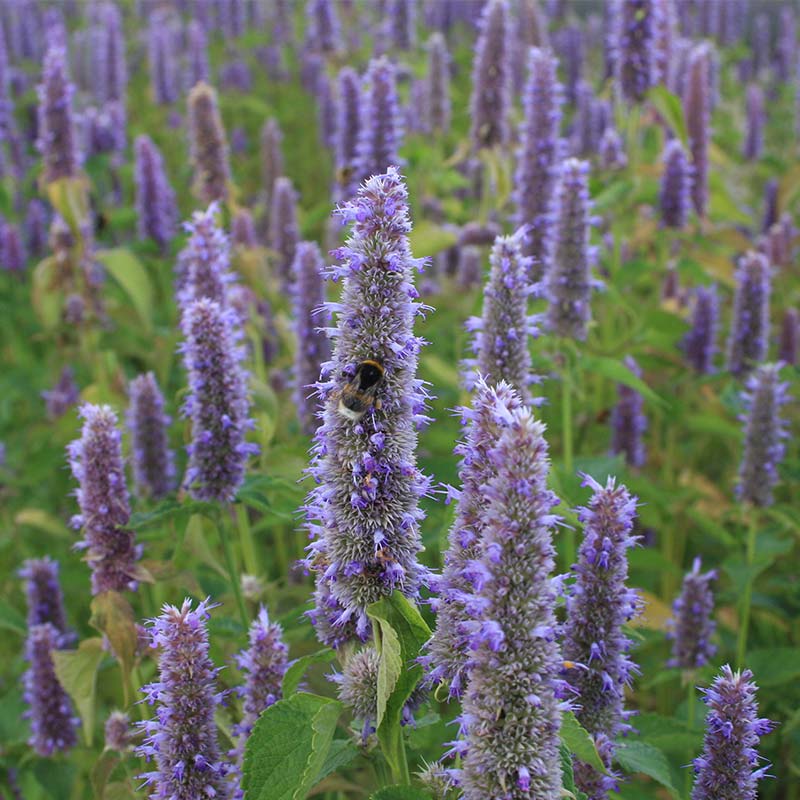
Hyssop flourishes with minimal effort and, like many mints, tends to take up on its own once planted. It is a favourite for honeybees and butterflies, who flock to its vibrant purple flowers.
To make medicine, harvest the fresh aerial leaves and stems while in flower:
- Fresh: Tinctures well with 60% alcohol.
- Dried: Harvest and dry for teas, or tincture at 40-50% alcohol.
The Formula for Success: Stimulant Expectorant
If you want to see Hyssop’s actions shine, look at this specific formula for “wet, boggy, mucus-laden coughs”:
- 50% Elecampane (Inula helenium)
- 40% Hyssop (Hyssopus officinalis)
- 10% Licorice (Glycyrrhiza glabra)
While the two four ingredients work to disperse stagnant phlegm and stimulate a productive cough, the Licorice acts as a necessary “demulcent” to ensure the formula doesn’t become too drying for the respiratory tissues.
Ultimately, Hyssop reminds us that while we can study chemical constituents, these ancient references offer a holistic insight into a plant that benefits the heart, mind, body, and soul and that’s exactly what you find in our Green Files. If you’re interested in more of this, that’s the place.