How Britain’s hospitals ran on weeds collected by Boy Scouts during WWII
- Roland Koronya


The Request
In 1941, the Royal Botanic Gardens at Kew received an unusual request from the Ministry of Health.
The nation was running out of medicine.
Not all medicine. There was no shortage of aspirin or morphine from the pharmaceutical factories. But here’s what’s interesting: the raw materials for countless essential drugs—the plant-based medicines that still formed the backbone of hospital formularies—came from occupied Europe and beyond. Digitalis from Germany. Belladonna from Eastern Europe. Ergot from France. And German U-boats prowling the Atlantic meant the ships carrying these materials weren’t getting through.
So Kew Gardens did something remarkable.
They organized a nationwide network of hedgerow harvesters. Mostly Women’s Institutes and Boy Scout troops. By 1943, collection guides had been distributed to every rural county, detailing exactly what to pick, when to pick it, and how to dry and bundle it for delivery. Hospitals, for the first time in the modern era, were being supplied not by pharmaceutical companies but by volunteers walking the lanes with baskets.
Think about that for a moment. Britain’s hospitals—treating wounds, infections, heart conditions—were suddenly dependent on housewives and children gathering weeds from ditches.
Now here’s the part that nobody mentioned, then or since.
This wasn’t actually a compromise.
The medicine growing in British hedgerows wasn’t inferior to what came from abroad. In many cases, for British bodies living in British conditions, it was better.
The Doctrine
Consider a principle in traditional herbalism that sounds, at first, like folklore.
It states that plants growing in a particular environment carry the medicine for conditions created by that same environment. Plants that thrive in bogs and damp places address boggy, damp conditions in the body. Plants that survive drought address dryness. Plants that grow in cold climates warm. Those from hot regions cool.
The old herbalists called this the doctrine of signatures, though that term has been muddled over time to mean something more simplistic—the idea that a walnut looks like a brain and therefore helps the brain. Which is sometimes true but often coincidental. The deeper principle is about correspondence between ecosystem and physiology.
A plant doesn’t just grow in an environment. It becomes a concentrated expression of that environment.
The Climate
Britain is damp.
Persistently, penetratingly damp in a way that shapes everything from architecture to temperament. The kind of damp that settles into stone walls and never quite leaves. The kind that six months of the year means you can’t hang washing outside without it coming back wetter than when you started.
British bodies—bodies that have lived in this climate for generations—develop patterns that reflect this. What herbalists call “damp tissue states” are extraordinarily common here. Sluggish lymphatic systems. Chronic low-grade inflammation. The boggy, congested feeling of fluid that won’t move properly. Conditions that involve accumulation and stagnation rather than deficiency or heat.
And the hedgerows that define the British landscape? Those dense, tangled borders between properties that have been there since medieval times?
They’re ecosystems of dampness. They thrive in it.
And they produce, in astonishing concentration, exactly the plants that address damp stagnation in human bodies.
Here’s what the Women’s Institutes were collecting in 1941.
What the Women Were Collecting
The Kew Gardens guides read like treasure maps if you know how to interpret them.
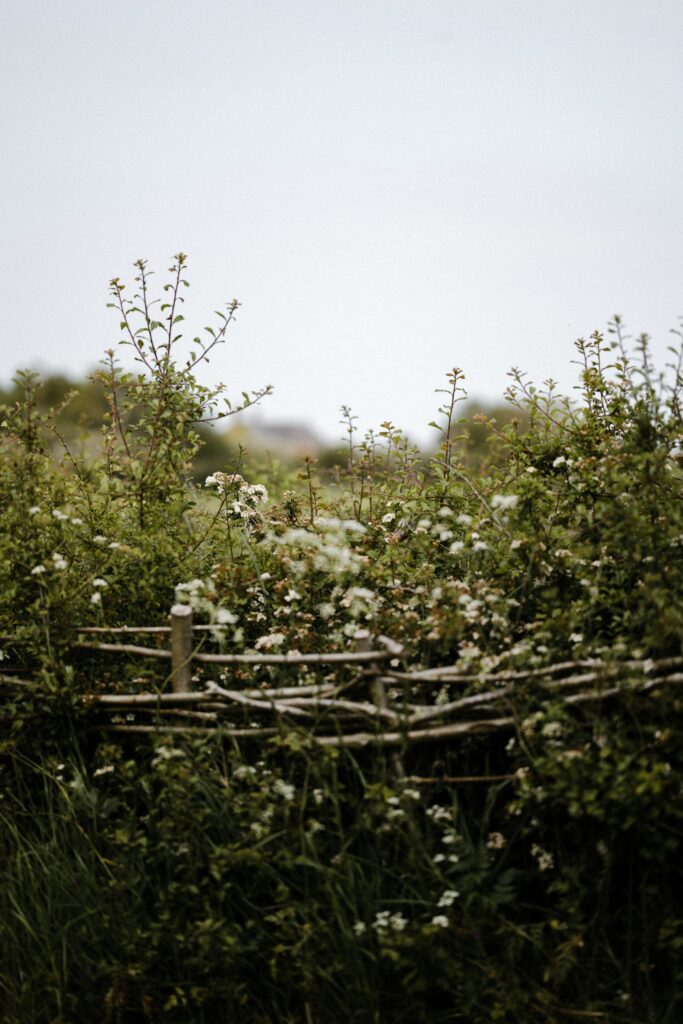
Nettle tops from the hedgerows. Elder flowers and berries. Dandelion root. Cleavers. Yellow dock. Hawthorn. These weren’t exotic medicines from distant lands. They were the plants growing in every ditch and fence line across Britain. Plants that had been growing there for thousands of years while people forgot what they were for.
Women from the local institutes would walk the lanes with scissors and baskets, harvesting according to precise specifications. Nettle tops before flowering, when the leaves are most potent. Elder flowers on dry mornings after the dew has lifted. Dandelion roots in autumn when the plant has drawn its energy downward.
The guides were exacting because the chemistry mattered. But also because the timing mattered—when a plant’s energy is concentrated in leaves versus roots versus flowers changes not just potency but the nature of the medicine itself.
What were they collecting, without necessarily knowing it in these terms?
Alterative herbs. Lymphatic herbs. Diuretics and gentle bitters. Plants that move stuck fluid, clear congestion, support elimination through kidneys and lymph and liver. Plants that address exactly the pattern of damp stagnation that the British climate creates in British bodies.
Take nettle. The plant everyone knows as a nuisance, stinging exposed ankles on country walks. It’s a powerful alterative—a blood purifier in old language, though what it actually does is support the body’s natural elimination pathways. It’s diuretic, moving excess fluid. It’s mineral-rich, building blood. And it’s anti-inflammatory, cooling the kind of hot, damp inflammation that manifests as allergies, eczema, and joint pain.
All conditions that are remarkably common in Britain and remarkably responsive to nettle.
Or cleavers. That sticky plant children throw at each other because the tiny hooks catch on clothing. It’s one of the best lymphatic herbs in the materia medica, specific for moving sluggish lymph and reducing the kind of chronic low-grade swelling that people often don’t even recognize as abnormal because they’ve had it so long. The doctrine of signatures is obvious here—the plant itself clings to everything it touches, just as lymphatic stagnation causes tissues to cling to excess fluid.
The Unexpected Result
By 1943, British hospitals were using medicines made from British hedgerows to treat British patients.
And something unexpected happened.
They worked.
Not despite being local and common, but perhaps because of it. A patient in a Liverpool hospital with chronic inflammation and poor lymphatic drainage responded better to nettle and cleavers—plants that grew in the same damp climate that created the condition—than to imported medicines designed for different bodies in different places.
The hedgerow isn’t just a convenient source of medicine. It’s a pharmacy specifically formulated for the conditions that arise in its own geography.
Elder, growing in every hedgerow across Britain, produces berries and flowers with different properties based on the season. The flowers, harvested in late spring, are cooling and drying—perfect for the hot, damp fevers and respiratory infections of early summer. The berries, ripening in autumn, are more cooling and astringent, suited to supporting immunity as the year turns cold and damp diseases proliferate.
Hawthorn, that thorny guardian of British field boundaries, is the supreme heart tonic. Not coincidentally, cardiovascular disease follows particular patterns in Britain—often involving poor circulation, cold extremities, and the kind of sluggish blood flow that comes from chronic damp conditions. Hawthorn addresses this not through any single chemical constituent, but through its complex effect on the cardiovascular system as a whole, improving both circulation and the strength of the heart muscle.
Yellow dock root, dug from hedgerow edges in autumn, is another alterative and bitter digestive. It moves stagnation through the liver and bowels, supporting the body’s primary elimination routes. It’s for the person whose digestion is sluggish, whose skin is congested, whose energy is low not from deficiency but from accumulation—from the body holding onto what it should release.
What Happened After
When the war ended and supply lines reopened, the hedgerow harvest stopped.
Hospitals went back to pharmaceutical suppliers. The knowledge didn’t disappear entirely—cottage herbalists and a few persistent practitioners kept it alive—but it faded from common use. The NHS, when it formed in 1948, was built on a pharmaceutical model. There was no room in its bureaucracy for volunteers with baskets collecting elder flowers.
And so two things happened simultaneously.
First, Britain forgot that its hedgerows held medicine.
Second, the patterns that hedgerow medicine addressed—the damp, sluggish, stagnant conditions endemic to the British climate and British bodies—became chronic health problems managed with pharmaceuticals that suppress symptoms rather than address patterns.
The person with chronic inflammation takes anti-inflammatories indefinitely. The person with poor lymphatic drainage and recurring infections cycles through antibiotics. The person with skin conditions that flare every time it rains gets steroid creams.
None of these are wrong exactly. But none of them recognize that the body is responding to its environment, and the environment has already produced the medicine for that response.
The Return
Walk any footpath in Britain today and you’ll pass the same plants that filled wartime hospital dispensaries.
They haven’t gone anywhere.
Nettle still stings in the ditches. Cleavers still catches on your trousers. Elder still flowers white in May and fruits dark in September. The hedgerows are still there, though many have been grubbed up for industrial farming, and the ones that remain are often unmanaged, wild, tangled.
But the knowledge is returning. Slowly.
People are beginning to remember that medicine doesn’t have to come from distant places. That the most effective remedies are often the ones growing in the same conditions that created the imbalance. That a damp climate producing damp conditions in bodies has also produced, with elegant precision, plants that address exactly those conditions.
This is vitalist herbalism at its most practical. Not exotic or mystical, but grounded in the simple observation that bodies and plants adapt to the same environments and therefore speak the same language.
The hedgerow isn’t just scenery. It’s a living formulary, written in the language of the land, waiting for someone to remember how to read it.
Learning to see this—to recognize both the patterns in your own body and the medicines growing at your feet—is what we explore in our Herbal Foundations Course, where British plants and British bodies come back into conversation after decades of unnecessary silence.