Echinacea Was Never Meant for Your Cold
- Roland Koronya


It is a Tuesday morning in October, and the 7.42 is full of people who should be at home. Somewhere between the third sniff and the fourth, a hand goes into a coat pocket and comes out with a small brown bottle. A few drops under the tongue, a tingle, a wince at the taste, and the day carries on. Echinacea is the herb that Britain reaches for at the first scratch in the throat, and you will find it by the till in almost every chemist in the country.
Here is the oddity. The people who made echinacea famous, well over a century ago, would not have recognised that carriage. They were not selling it for colds. They were selling it for blood poisoning, boils, and snakebite.
The Blood Purifier Nobody Mentions
The old word for what echinacea was believed to do is alterative: a herb that changes the condition of the blood and the lymph, clearing what has gone foul. Finley Ellingwood, one of the great Eclectic writers, placed it in the first rank among all alteratives. It was reached for sepsis, boils, and deep infections. Bites and stings from venomous creatures, which the peoples of the Great Plains had treated with it long before any European doctor heard of it. In a description that reads almost like a riddle, the plant’s spiny cone was linked by those who used it to the tail of a rattlesnake.
The way it reached medicine is a small piece of theatre. In the late 1880s, a Nebraska doctor of uncertain credentials named H. C. F. Meyer approached the Eclectic physicians of Cincinnati with a proposition. He had a root, he said, that could cure almost anything, and he would prove it by letting a rattlesnake bite him and treating himself with nothing else. The doctors declined, reasonably suspecting they were being sold something. A few tried the root anyway, though, and John King, author of the standard Eclectic dispensatory, reversed his early scepticism and began recommending it. Within a generation, echinacea was the most prescribed medicine made from an American plant, and it stayed that way through the 1920s. Notice what Meyer was selling: snakebite, typhoid, blood poisoning. Not a sniffle.
Taste it and you understand why it was trusted for this. A fresh preparation prickles on the tongue, a tingling that is less a flavour than a sensation, pungent and diffusive, spreading outward through the mouth. In the vitalist reading it is cooling and stimulating, neutral to slightly drying, a herb for damp-heat patterns: infections that are red, swollen, and angry, with lymph glands standing up like fists. Its cooling quality answers the heat; its stimulating quality gets sluggish tissue moving again. The same plant addresses both excitation and depression, a wide range that hints at real force.
This is not a gentle plant for a mild complaint. A red streak creeping up the arm from an infected wound, the classic sign the old physicians called blood heat, is a medical emergency in the twenty-first century, not a gardening project.
How a Sepsis Herb Became a Sniffle Herb
So how did a remedy for septic wounds end up beside the paracetamol in October?
Part of the answer is simply that antibiotics arrived. With sulfa drugs and then penicillin, the serious infections echinacea had been prized for were handed to something faster, and American demand fell away. The root did not disappear, though. It was carried on in Germany, where commercial cultivation began around 1939 and where researchers began studying how its extracts act on the immune system. By the time it came back to America in force in the 1980s, it had been reintroduced under a new description: not a blood purifier but an immune stimulant, which is a much simpler idea, and a far easier thing to put on a label.
That simplicity is the real engine of the change. Marketing sells simple messages, and “boosts your immune system” is about as simple as a message can be. Once a herb is filed under one use, its other uses begin to fade from view. Elderberry becomes the antiviral herb, saw palmetto the prostate herb. Echinacea became the cold herb. Its immune-stimulating reputation is, by the standards of herbal history, fairly modern. Its older work, quieter and more serious, simply stopped being said aloud.
The Farmer Who Couldn't Sit Still
Here is the part that bothers vitalist herbalists most, and it is not really about the plant at all. It is about what people do on the day they start taking it.
The modern routine goes like this. You feel the first scratch in the throat, take a squirt of tincture every half hour or so, and go to work anyway, because there is a deadline, a train, a child to collect. You feel a little better, so you carry on.
The American herbalist Matthew Wood had a name for the type who does this. He called echinacea the farmer’s remedy: the herb of the person who simply cannot stop, who works through the warning signs and gets sick on the first day of a holiday. Britain, a country with a proud tradition of turning up to work with a streaming nose and calling it resilience, has produced a great many farmers in this sense.
The vitalist view is that the body has an innate intelligence and its symptoms are a form of language. A cold, on this reading, is not a malfunction. It is the body telling you in plain terms that you have been running on empty and need to slow down. The old saying runs that there is no cure for the common cold because the common cold is the cure, and the argument is that suppressing the message, whether with a pharmacy product or with a stimulating herb taken while you carry on exactly as before, means the underlying pattern has not changed at all. Echinacea is a cooling stimulant. Pushing a stimulant into a body already running hot and depleted risks overstimulating the very system that needs rest. An old grandmother’s rule, one day of rest for each day of fever, is a useful corrective. So is the plainer advice: go to bed, and stay in bed.
It does not mean echinacea has no place in the early stages of illness. It means the herb works best when it is part of a pause, not a substitute for one.
A Prairie Plant in a British Border
Here is what gives this story its curious British twist. You do not need to import echinacea. You almost certainly have a neighbour who grows it.
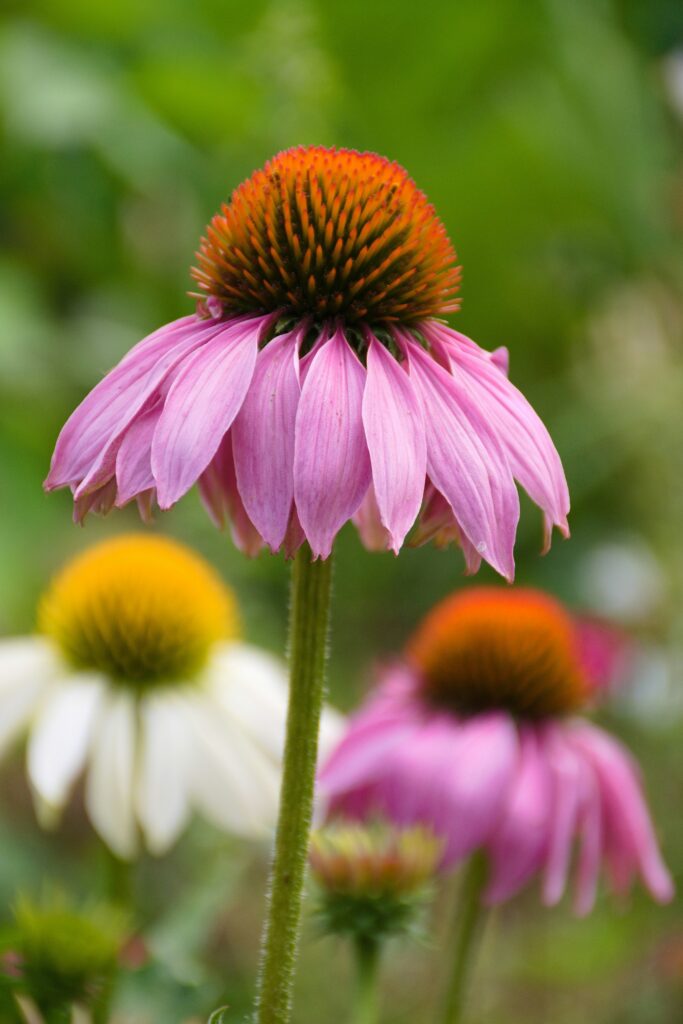
Echinacea purpurea is native to the prairies and open woods of central and eastern North America, which makes it as foreign to Britain as the snake in Meyer’s wager. But it has made itself at home. The Royal Horticultural Society rates it hardy across most of the country, even through severe winters, and lists it among the plants suited to cottage and informal gardens, prairie planting, and wildlife borders. It flowers from midsummer into autumn, and bumblebees and butterflies, Red Admirals and Painted Ladies among them, work the cones until the first frosts.
It likes good drainage and full sun, and the most common cause of failure is a waterlogged border, which in much of Britain is a genuine hazard. It is also not a long-lived plant, perhaps two to five years in many gardens, so dividing the clump every three or four years in spring keeps it vigorous. A plant you divide and replant yourself is a plant you are not taking from somewhere else, which matters, because the wild root trade has put real pressure on prairie populations.
What It Was Actually For
If you grow echinacea, or buy a well-made root tincture, the traditional approach looks rather different from the modern one. It is a short, acute herb, used for days, not weeks, for the person who is truly stuck in heat and congestion: swollen glands, a stubborn infected wound, a boil that will not come to a head. It is not a daily tonic to be taken all winter in the hope of repelling every virus that passes. People allergic to the daisy family, which includes chamomile and ragwort, should be cautious about it. And anything that looks like serious infection belongs with a doctor first.
The Cold, Properly Understood
There is something quietly humbling in learning that the most familiar herb on the pharmacy shelf has been misunderstood for most of a century. Not dangerously misunderstood, just narrowed. A root that once stood at the edge of life and death was reduced to a gesture we make at the start of an ordinary cold, and the gesture, as it turns out, was never the point. The point was always the pause that should come with it.
Learning to ask what a plant was actually for, before asking what it is being sold as, is the kind of patient reading we explore together in our Herbal Foundations Course. The coneflower in the border is still doing what it has always done: standing tall in the late light, waiting for the bees. The next time the scratch in your throat arrives, it might be worth listening to what it is trying to say, and putting the kettle on.