
Chamomile (Matricaria recutita, Chamaemelum nobile)
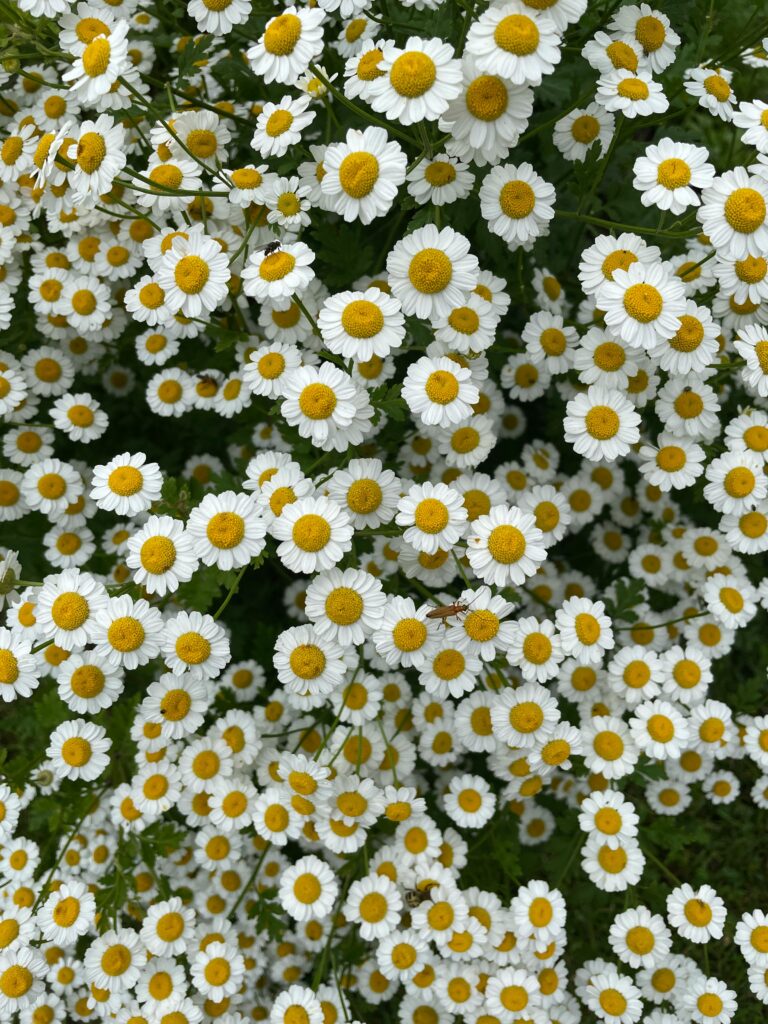
We all know this plant. We know it even if we don’t know that we know it. Its tiny white petals, that unmistakable yellow center, the scent of warm honeyed apples. Chamomile. For many of us, it’s the very first herb we ever met—offered in a steaming mug, perhaps by a parent, maybe a grandparent. A gesture of care. A way of saying, without words, “rest now.”
And this is where things get interesting.
Because that innocent little flower—the one you associate with childhood, with bedtime stories and soft blankets—happens to be one of the most widely used herbal remedies in the world. It’s not just soothing. It’s astonishingly versatile. In fact, chamomile has earned a solid place in every well-stocked first aid kit, and has done so for centuries.
An English herbal from 1690 puts it this way:
‘Tis a great Cordial, giveth ease and causeth sweat… it sweats strongly, eases Pain at the Stomach, and cures Agues… boil a handful in a pint of Ale till half consum’d, then strain and drink it before the Fit comes, and sweat… do this three times and it cures.’
There’s something humbling about that kind of continuity—how a plant can pass through generations, languages, and medical paradigms, and still hold its ground.
Let’s break it down.
- Common Names: Chamomile, German Chamomile, Roman Chamomile, Manzanilla (Spanish), Maythen (Saxon)
- Latin Names: Matricaria recutita, Chamomilla recutita, Matricaria chamomilla, Chamaemelum nobile
- Family: Asteraceae
- Parts Used: Aerial parts
- Distribution: Originally spread across Europe, temperate Asia, and North Africa. These days, it’s grown all over—from Germany to Egypt, France to Argentina.
Now, to the part that often causes confusion: species.
There are many varieties of chamomile, but in herbal medicine, two stand out—German and Roman. They’re both used extensively, often interchangeably, but they’re not the same.
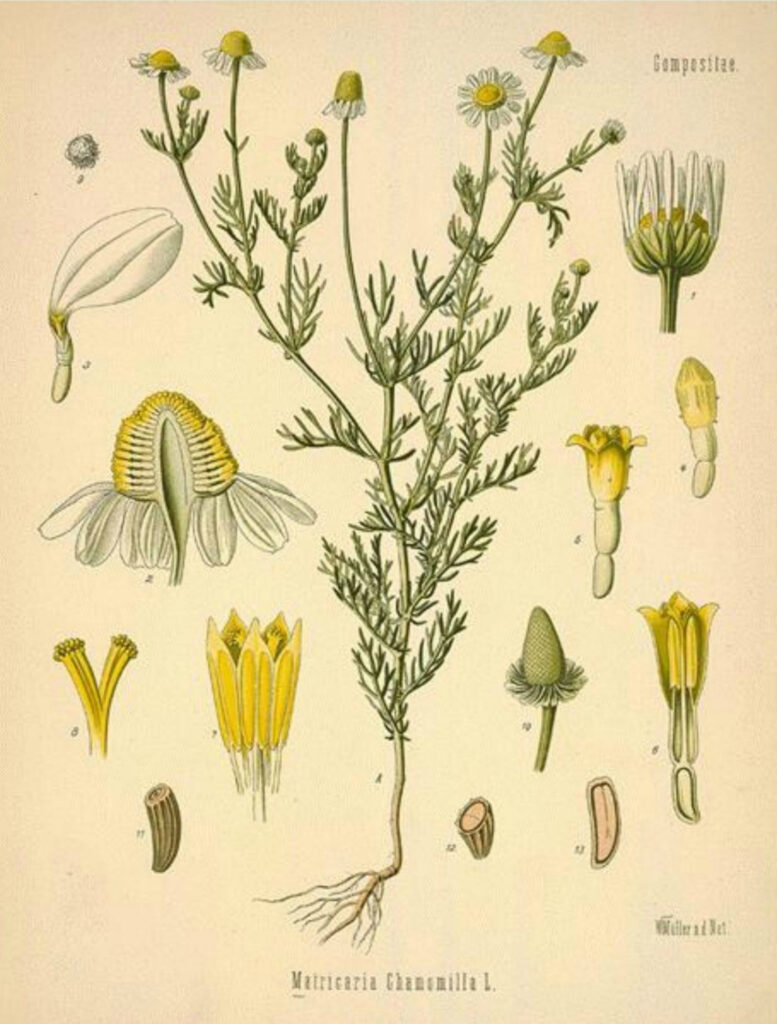
German Chamomile (Matricaria recutita) is considered the “true” chamomile. It’s an annual—meaning it completes its life cycle in one season—and it self-seeds generously. Growing anywhere between 10 and 80 cm, it thrives in well-drained soils and open sun. And here’s the part herbalists love: German Chamomile blooms often, making it an excellent candidate for drying, storing, and keeping your pantry full.
It also offers something rare in the plant world—a royal blue essential oil, thanks to its high content of chamazulene. That’s what gives it not just therapeutic strength, but a kind of elegance. There’s something quietly powerful about a plant that grows from spindly roots in ordinary soil, and yet produces an oil of such vivid, improbable color.
Roman Chamomile (Chamaemelum nobile) tells a different story. This one is a perennial—it comes back year after year. It’s lower to the ground, often just a 2-5cm tall, and it spreads by creeping roots. You’ll find it in British gardens, filling spaces between stones, lining pathways. It doesn’t produce as much of that blue oil. Instead, its essential oil is clear. But it shares the sweet scent, the familiar flower, and the same calming, comforting effect.
Interestingly, while they differ botanically, both types share the same key medicinal trait: it’s the flowers that do the work. That’s where the potency lies.
And here’s a curious detail—one that speaks to chamomile’s remarkable resilience. Even when it grows wild, its flowers don’t seem to absorb or retain environmental toxins. Which makes it, by some accounts, one of the safer wild herbs to harvest. Of course, clean environments are always preferred. But it’s worth noting: chamomile doesn’t just heal. It protects.
And maybe that’s why we’ve trusted it for so long.
A Brief History of Chamomile
Chamomile has been with us for a long time. And not just in the folkloric sense—passed down in whispers and bedtime tea rituals—but in the written record. It shows up in the medicinal writings of Egypt, Greece, and Rome. That alone is impressive. But then you realize: this plant caught the attention of Hippocrates, Dioscorides, and Galen—the founding minds of Western medicine. And suddenly, that little yellow flower becomes something more than quaint. It becomes foundational.
The Greeks called it kamaimelon. Kamai, meaning “on the ground,” and melon, meaning “apple.” Ground apple. A name born from proximity—both botanical and sensory. Chamomile grows low, close to the soil. And its scent? A gentle sweetness, like bruised apples in the sun. It’s easy to see why they chose the name. It’s the kind of detail that sticks.
And then there’s the Roman chamomile. According to one account, it was discovered—almost poetically—growing in the cracks of the Colosseum. Picture that for a moment. An ancient ruin of power and spectacle, now softened by small white flowers sprouting from between stones. An English botanist saw it there, brought it home, and planted it into British gardens, where it eventually made its way into the everyday life of a nation.
But chamomile wasn’t just admired. It was sacred.
In the Lacnunga, an 11th-century Anglo-Saxon manuscript, there’s mention of nine sacred herbs—plants believed to hold special power and protection. Chamomile was one of them. That’s significant. These were not casual remedies; they were the core of early medicine. Plants of ritual and reverence.
And the Vikings? They had their own ideas. Chamomile was part of their grooming—used as a rinse or shampoo, possibly for its scent, perhaps for its shine. Either way, it found its way into warrior culture, braided into the locks of seafarers and storytellers.
But maybe the most surprising twist in chamomile’s history is this: before hops became the go-to bittering agent in beer, brewers turned to chamomile. It was used in fermentation. It added body, depth, and subtle floral notes. You’ll even find it listed in ancient absinthe recipes—its bitter sweetness mingling with other potent herbs.
A plant that settles children at bedtime. That once helped cleanse Viking hair. That found its way into sacred Anglo-Saxon texts, and into the mugs of medieval brewers. Chamomile doesn’t shout. But it shows up—again and again—quietly shaping the human story.

The 5 Pillars of Chamomille
Taste
We think we know the taste of chamomile. It’s the flavor of comfort, after all—soft, floral, a little sweet. It’s the tea they serve on airplanes to calm nerves, the one tucked into the back of your cupboard for nights when you want something warm but not caffeinated. Mild. Familiar.
But here’s where things get interesting.
Chamomile has layers. The version most of us know—those tidy little bags on grocery store shelves—barely scratch the surface. When you step beyond the commercial blend and into the world of whole herbs, everything changes. The flavor becomes more complex, more assertive. Lighter infusions give you the familiar sweetness, that faintly aromatic profile that whispers “relax.” But push a little further—steep a little longer, use a little more—and chamomile shows another side entirely.
It gets bitter.
Not unpleasantly so. Not aggressively. But in a way that reminds you: this is medicine. This is a plant that’s doing something.
Chamomile’s taste sits at the intersection of three flavor worlds—aromatic, bitter, and sweet. And the balance shifts depending on how you brew it. Time becomes the deciding factor. A short infusion? Light, floral, gentle. A long infusion—say, 20 minutes or more—brings out the bitterness, the grounding, cooling edge.
Then there’s the oil.
It’s what gives chamomile its warmth. Not hot, exactly. But slightly pungent. Inviting. And yet, somehow, it doesn’t overheat. The bitterness tempers the warmth. The cooling energy reins in the aromatic fire. It’s a kind of built-in equilibrium—one that makes chamomile suitable for nearly everyone. Adults. Children. The warm. The cool. The restless. The depleted. It fits.
If you’re an herbalist—or someone who wants to understand what plants really have to say—there’s a simple test. Take a 1l mason jar. Fill it halfway with dried chamomile flowers. Pour in boiling water. Put the lid on. Wait 20 minutes.
Then taste.
Not a sip from a tea bag. Not a teaspoon steeped for five minutes. But a deep, medicinal infusion. What you’ll discover is that chamomile isn’t just soothing—it’s complex. Grounded. Functional. And very much alive on the tongue.
It’s in that moment—when the sweetness fades and the bitter arrives—that you begin to realize: chamomile isn’t just gentle. It’s powerful. Quietly so.
Primary Actions
Chamomile has a reputation. Most people think of it as a sleepy-time tea—a kind of herbal lullaby. And yes, it does help people rest. But if that’s all you think it does, you’re missing the bigger story.
Chamomile is far more than just a sedative. In fact, when you look closely, you find that its effects aren’t only widespread—they’re intricately connected. It’s not one action. It’s a series of interlocking actions that speak to the body on multiple levels.
Let’s start with the nervous system.
Chamomile is a nervine sedative. That means it works on the nerves, gently easing the body into calm. Its effect is mild to moderate—not overwhelming, not numbing—but that doesn’t mean it isn’t powerful. This is one of the great paradoxes of herbal medicine: the gentlest remedies often run the deepest. Chamomile is a perfect example.
It’s one of the few herbs that can be used safely for children, especially those prone to restlessness or emotional outbursts. Many kids even enjoy the taste. It soothes without sedating. It relaxes without dulling. And because of its sweet taste, there’s something slightly nourishing about it, too—like it’s feeding the nerves, not just quieting them.
But chamomile doesn’t stop there.
It’s also what herbalists call a bitter carminative—a rare combination. It contains both bitter compounds and aromatic volatile oils. These two actions—bitters and carminatives—are often paired in herbal formulas because they complement each other so well. Bitters stimulate digestion, while carminatives soothe the gut and ease spasms. Chamomile does both, all on its own.
It increases digestive secretions, promotes circulation to the gut, and has a relaxing effect on the entire digestive tract. Think of it as a built-in formula—a self-contained system for restoring digestive harmony. Gentian and ginger often work together in the same way, but chamomile achieves this dual action within a single plant.
And then there’s its ability to relax smooth muscles—a spasmolytic effect. While it’s not particularly effective for skeletal muscle tension, its actions on the internal muscles—especially in the gut—are profound. It gently calms cramping, reduces spasms, and is especially effective in the case of colic. That’s why it’s a go-to for fussy babies.
But chamomile goes even further.
It’s a relaxant diaphoretic—meaning it helps open the skin’s pores, promotes sweating, and allows heat to escape during a fever. This is not a dramatic, sweat-it-out kind of herb. It’s more strategic. It’s used later in the fever process, when the body is hot, flushed, and tense—both physically and emotionally. In this case, the bitterness, aromatic oils, and nervine qualities work together to release tension and lower internal pressure. Gently, but effectively.
Chamomile also has a role in reproductive health. As an emmenagogue, it supports menstrual flow and eases premenstrual symptoms. How? Again, it’s the combination of actions: the bitter quality helps stimulate liver function and move stuck hormonal energy, especially excess androgens. The aromatic oils help disperse stagnation and encourage healthy blood flow. And the nervine sedative calms the emotional and physical turbulence that so often accompanies hormonal cycles.
Its influence doesn’t stop there.
Chamomile is an inflammation modulator. The plant contains powerful compounds—flavonoids like apigenin and luteolin, and essential oils like azulene and chamazulene. These substances work to reduce inflammation, especially in the gut. That’s crucial, because gut inflammation doesn’t stay in the gut. It tends to radiate outward—manifesting as joint pain, skin conditions, autoimmune issues. Chamomile, taken internally, helps cool this systemic heat.
Even inhaling chamomile steam can help reduce inflammation in the respiratory tract. Think sinusitis, rhinitis, allergy-related inflammation. Sometimes, the simplest form—just a hot mug under the nose—is all you need.
And yes, chamomile is antimicrobial. Its essential oils show broad-spectrum activity, helping to inhibit or kill a wide range of harmful microbes. It can be used topically to clean wounds and prevent infection, or internally to support the gut against microbial overgrowth. The essential oil—used with care and properly diluted—is especially potent in this regard.
Finally, chamomile is a vulnerary. That’s the herbal term for something that speeds wound healing. It reduces inflammation, prevents bacterial infection, and encourages tissues to regenerate. It keeps things moving—fluids, blood, healing energy—so stagnation doesn’t take hold.
In other words: chamomile is far more than it appears.
It’s the kind of plant that works gently but persistently—balancing, modulating, easing. Its gifts are subtle, yes. But they are also sophisticated.
It doesn’t just help you sleep.
It helps you heal.
Affinities
Every herb has its favorite places in the body—places it seems to understand better than others. Chamomile is no exception. It has affinities, and once you start to map them out, you begin to see a pattern. A quiet intelligence. A kind of herbal intuition.
Chamomile works primarily on five key systems. These aren’t just vague targets—they’re the exact places where its actions show up most clearly. And what’s fascinating is how each effect we’ve already explored—bitter, carminative, nervine, inflammation modulator—expresses itself through these specific channels.
Let’s take a closer look.
The Digestive System
This is chamomile’s home base. It’s where the plant seems to do some of its most reliable work. The bitter and carminative actions team up here to increase gastric secretions, support digestion, and reduce inflammation. Meanwhile, its spasmolytic properties ease muscular tension and help settle the kind of digestive discomfort that often arises from stress, stagnation, or both.
The Nervous System
Chamomile is, above all, a plant that calms. Its nervine sedative qualities help the nervous system shift gears—from the high-alert, fight-or-flight mode of the sympathetic system to the rest-and-digest mode of the parasympathetic. This isn’t just about inducing sleep. It’s about restoring balance. Later, we’ll dive into the psychological patterns chamomile seems particularly attuned to—but the general picture is clear: it soothes from the inside out.
The Upper Respiratory System
Inhaled as a steam, chamomile acts on the respiratory tract like a gentle balm. The volatile oils coat and soothe the mucous membranes, reducing inflammation, easing sinus pressure, and calming the lungs. Its antimicrobial activity adds another layer of protection—quietly clearing out pathogens while it comforts.
The Female Reproductive System
Here, chamomile works more like a system of levers and pulleys. Its bitter tonic qualities create a downward-moving energy that can help initiate delayed menses. At the same time, its ability to relax smooth muscle addresses uterine cramping, while the nervine aspect helps ease PMS-related tension. Add in its effect on liver stagnation, and you have a plant that doesn’t just target symptoms—it moves stuck energy.
The Immune and Febrile Systems
Chamomile’s role here is supportive rather than stimulatory. It doesn’t ramp up the immune system like echinacea, nor does it act as an alterative in the classic sense. But as a relaxant diaphoretic and gentle antiseptic, it helps manage the discomfort and tension that often come with fevers. It assists the body in releasing heat, sweating out illness, and calming the internal environment so healing can happen more efficiently.
So yes, chamomile is gentle. But that gentleness is strategic. It listens before it acts. And where it chooses to act, it does so with quiet precision.
Energetics
Herbalists often talk about plants in terms that seem almost poetic: hot, cold, dry, damp, tense, lax. These aren’t just metaphors—they’re energetic signatures. And when you learn to recognize them, you begin to understand a plant not as a list of chemical compounds, but as a presence in the body. Chamomile, for instance, doesn’t just “help.” It moves. It cools. It dries. It relaxes. And it does all of this in very specific, very telling ways.
Chamomile is a plant of contrast. It blends bitter and aromatic, two energetic directions that don’t always align. Bitters are almost always cooling. Aromatics are typically warming. So what happens when a plant contains both?
In the case of chamomile, the answer is surprisingly clear: cooling wins. Azulene and chamazulene—the cobalt-blue compounds in chamomile’s essential oil—are distinctly cooling. The bitterness reinforces this, drawing down excess heat, calming inflammation, and grounding the body’s excesses. Even the color gives it away: that deep blue speaks the language of cool.
But chamomile is also drying. This shows up through its diaphoretic action—encouraging sweating, releasing heat—as well as through its bitter drainage and the dispersing quality of its aromatic oils. It lifts moisture out, clearing damp congestion, especially when it’s tangled up with tension or heat.
Still, the most pronounced energetic action of chamomile isn’t temperature or moisture. It’s tone.
Chamomile is, above all, a relaxant. That action starts in the nervous system and echoes outward—into the smooth muscles, the digestive tract, the uterus, even the subtle tissues of the lungs. It soothes tension. It softens constriction. It lets the body exhale.
There’s even a mild stimulant quality, thanks to the aromatics—but this is targeted, not jittery. It increases circulation, particularly to the digestive organs. The body warms up where it’s needed, not across the board.
So what does this mean in terms of tissue states?
Chamomile is a key remedy for two classic patterns: wind/tension and heat/excitation.
Start with wind/tension. This isn’t a single symptom—it’s a pattern of shifting discomfort. You see it in the digestive system: gas, bloating, alternating constipation and diarrhea. You see it in the nervous system: insomnia, restlessness, nervous tension. There’s a sense of things being unstable, unpredictable, always moving—like wind through a field.
And at its root? The sympathetic nervous system. The fight-or-flight mode. When this is dominant, muscles tighten, nerves overfire, digestion halts. We become—quite literally—a ball of nerves. Chamomile steps in here as a soft interrupter. It doesn’t overpower. It just guides the system gently back toward parasympathetic calm.
This pattern—constantly changing symptoms, sudden flare-ups, alternating sensations—mirrors what some systems of medicine call vata. It’s movement without rhythm. And chamomile, with its calming, steadying presence, becomes an anchor.
Then there’s heat/excitation. This state is easier to spot: redness, swelling, fever, rapid pulse, inflammation. It’s not just heat in the thermal sense—it’s metabolic heat. Cells moving too fast, systems burning too brightly. And like wind/tension, this too often traces back to the nervous system—or the liver, especially when emotions like anger or frustration start to overflow.
Here again, chamomile shines. Its bitter elements cool the liver. Its nervine quality calms irritability. Its inflammation modulatory action quiets the “too much” that defines excitation. And when mucosal tissues are involved—especially in the gut or lungs—chamomile acts like a hush. It dials down the restlessness, the excess, the rawness.
It’s easy to overlook chamomile because it’s so common. But beneath its sweet scent and childlike reputation lies a deeply intelligent plant—one that knows how to read the body’s patterns, and offer exactly what’s needed in return.
Specific Indications
There are moments when a plant’s effect on the body tells only half the story. Chamomile is one of those plants. Because while its physiological actions—calming, cooling, relaxing—are well-documented, it also has a distinct psychological presence. It doesn’t just soothe the stomach. It soothes the soul.
Herbalist Matthew Wood captures this beautifully. He describes chamomile as a remedy for “acute digestive upset, coming on after vexation and anger; with heat of the face, thirst, taste of bile, nausea, vomiting of bile, anxiety, restlessness.” In other words: emotional heat that bubbles over into the body. Rage that becomes reflux. Frustration that lands in the gut.
And this is where chamomile’s emotional intelligence becomes clear.
It’s an ideal ally for children—not just because it’s gentle, but because it meets them where they are. It calms the child who can’t quite express what they’re feeling. The one who throws a tantrum for seemingly no reason. The one who melts down, wants everything and nothing, and can’t be soothed—unless you carry them, rock them, or give them a warm sip of something familiar.
But this isn’t just about children.
Chamomile, in many ways, is a plant for the childish adult—the grown-up whose coping strategies never quite matured. The person who whines, complains, lashes out, then expects someone else to fix it. The one who never quite learned how to self-regulate, because somewhere along the way, they never had the chance to grow up on the inside.
Matthew Wood describes this as “petulant, quarrelsome, vitiated humor… contrary to normal condition, out of humor, particularly at menses or when sick.” He calls it “babies of any age.” It’s a remarkably accurate phrase—because it captures not only the outward behavior, but the deeper emotional stuckness behind it.
These are the people who complain constantly, who seem irritated by everything, and who react to small inconveniences with outsized frustration. But if you look a little closer, what you’ll often find is an overwrought nervous system. Years of chronic stress. Emotional exhaustion. A part of them still stuck in a younger stage of life—perhaps frozen there by early trauma or unmet emotional needs. Chamomile doesn’t scold them. It doesn’t push them forward. It simply softens the edges. It allows space for calm to return.
There’s a gentleness in that. But also a kind of profound respect.
And it’s not just about calming nerves—it’s about restoring dignity. Chamomile improves self-esteem. It “sweetens the soul,” as Wood puts it. It doesn’t just take away the irritability. It helps people feel safe enough to stop lashing out.
I often find it useful to contrast chamomile with lemon balm. Both are calming herbs. Both are used to settle the nervous system. But while chamomile is for the childish adult, lemon balm is for the overly serious one. Chamomile helps the adult who never really left childhood behind. Lemon balm helps the adult who’s forgotten how to return to it—who needs to reawaken their playfulness, their lightness, their joy.
One soothes immaturity. The other melts rigidity. And together, they paint a fuller picture of how plants meet us where we are, and gently help us become who we’re meant to be.
Clinical Patterns
1. Chamomile and the Gut: A Nervous System Story
Let’s start with a simple term: dyspepsia. It sounds clinical. Maybe even harmless. It’s usually described as indigestion—belching, bloating, gas. The kind of thing people dismiss as “mild.” But when these symptoms become chronic, they’re telling us something. The body is whispering, quietly but insistently: something isn’t right.
Often, the root of that problem isn’t complex. People are eating foods that don’t suit their constitution, or they’re eating them in the wrong state of mind. And this is where chamomile comes in—not as a cure-all, but as a bridge between the nervous system and digestion.
Because here’s something not often appreciated: digestion is not just physical. It’s neurological.
The digestive system only works properly when we’re in parasympathetic mode—that calm, rest-and-digest state. But many of us live in the opposite state: sympathetic dominance. Fight-or-flight. Hyper-alert. Stressed. We eat quickly, we eat distracted, and our bodies never quite make the switch into the mode where digestion actually happens.
Chamomile offers a gentle but powerful nudge.
It’s a nervine, yes. It calms the nervous system. But it also works directly on the digestive system—as a bitter, a carminative, an antispasmodic. It doesn’t just get the nerves to relax. It helps the stomach, liver, and intestines follow suit. This is why chamomile is so well-suited for people whose digestive complaints are wrapped up in tension. For those who need to “calm down a little bit more prior to eating,” chamomile is a quiet ally.
And then there’s ulceration—one of the more widespread digestive issues in modern life.
Ulcers can appear in the stomach, the small intestine, or the esophagus. They’re commonly attributed to H. pylori bacteria. But some herbalists turn that logic around: what if the ulcer came first, and the infection was opportunistic? After all, it’s not unusual to see wounds become infected—but it is unusual for an infection to spontaneously cause a wound.
This shift in perspective changes how we approach treatment.
Yes, there’s a microbial element. But the deeper issue is often inflammation. Or damage from long-term use of NSAIDs, which suppress the stomach’s ability to defend itself. Or chronic alcohol use, which disrupts healing. These causes have something in common: they compromise the body’s natural resilience.
This is where chamomile steps in again—not alone, but as part of a team. Demulcents like marshmallow, comfrey, and slippery elm soothe and coat. Vulneraries like calendula, plantain, and yarrow promote healing. Inflammation modulators like meadowsweet and—yes—chamomile, reduce irritation and support recovery.
Chamomile’s role here is triple-layered: it soothes, it heals, and it supports digestion. It brings calm to a system in distress.
And the scope goes beyond ulcers.
Chamomile can be helpful for leaky gut syndrome, colic, diarrhea, constipation, diverticulitis, heartburn, indigestion, inflammatory bowel disease, nausea, loss of appetite, and plain old stomachache. The actions don’t change. It’s still the bitter tonic. Still the inflammation modulator. Still the antispasmodic and the carminative.
It’s easy to categorize chamomile as just a nervine—a go-to for stress and anxiety. But doing so misses the point. Its effects on the digestive system aren’t secondary. They’re central. Chamomile is, quite simply, indispensable when it comes to digestive health.
And sometimes, the most powerful remedies are the ones we’ve known since childhood. The ones that don’t announce themselves. The ones that just work.
2. Chamomile and the Nervous System: A Gut-Level Calm
Chamomile is often typecast as mild. Gentle. Harmless. And it is—but that word shouldn’t be mistaken for weak. Because in the landscape of herbal remedies for the nervous system, chamomile holds a kind of quiet authority.
It’s a remarkably effective remedy for restlessness, irritability, and stress-related tension—the states of mind that don’t scream for help, but erode us over time. It calms the nerves. It relaxes the muscles. And it does both in a way that feels less like sedation and more like permission to exhale.
Where chamomile really shines is in the overlapping territory between the gut and the mind. That place where digestive upset and anxiety feed off each other in a kind of feedback loop. Someone feels stressed. Their stomach clenches. That discomfort causes more stress. And so on.
But this isn’t just poetic metaphor—it’s physiological fact.
The brain and the gut are deeply linked, connected through the vagus nerve and a complex network of biochemical signals. Modern researchers call it the gut-brain axis, but herbalists have been working with it for centuries. Chamomile doesn’t choose one end of the circuit. It speaks to both. Calm the gut, and the mind often follows. Calm the mind, and the gut begins to release. Chamomile does both.
As the herbalist Grieves once wrote, “It has a wonderfully soothing sedative effect and is absolutely harmless.” And that—especially for children—is where chamomile’s story begins.
For fussy, hyperactive, sensitive babies, chamomile is legendary. Its calming influence is gentle enough for the very young, and yet potent enough to turn a tantrum into a nap. Some parents even use it for kids diagnosed with ADD or ADHD—not as a cure, but as a way to take the edge off the swirl of energy, and help focus return.
But the plant isn’t only for children. Adults, too, have their moments of overwhelm.
Chamomile works beautifully for people who are nervous and irritable at the same time—a psychological profile we’ve already seen. It’s for those who live with tension just under the surface. The ones who might snap over something small. Who carry their stress in their gut, their shoulders, their sleep.
And it doesn’t sedate in the classic sense. People can take chamomile throughout the day without getting tired. And yet, for some, it’s the only thing that helps them sleep.
Take my friend—a fellow herbalist—who’s struggled with insomnia for years. He’s tried everything: valerian, hops, passionflower, skullcap. All the big names in herbal sleep support. Nothing worked.
Then he tried chamomile—not just as a tea, but as a spagyric essence, a form that preserves higher levels of volatile oils. Three drops. That’s all it took. He was asleep. Night after night.
Now here’s the surprising part: chamomile is typically considered weaker than all those other hypnotics. And yet, for him, it was the one that worked. Not because it was stronger, but because it was right. It matched his nervous system. His constitution. His internal wiring.
And that’s something important to remember: the best nervine isn’t necessarily the strongest. It’s the one that resonates. The one that speaks the same language as your nervous system.
Chamomile may be gentle—but it’s also precise. It knows who it’s for. And when it’s a match, the results can be profound.
3. Chamomile on the Surface: The Power of a Plant You Can See
We often think of herbs as something we ingest—tea, tincture, capsule. But chamomile breaks that boundary. It works not only inside the body, but on the body. And perhaps that’s part of what makes it so compelling. It’s versatile. It’s visible. It speaks to both surface and depth.
Used topically, chamomile is remarkably effective—and not just in one way. It’s an inflammation modulator. It’s antimicrobial. It’s antifungal. And German chamomile, in particular, brings something extra: its essential oil is rich in azulene and chamazulene—those deep blue compounds that reduce heat and calm irritated tissues.
So, what does this mean in practice?
You’ll often find chamomile used for skin conditions like rosacea, eczema, and psoriasis. It won’t cure them—that’s an important point. These conditions usually have deeper roots: food intolerances, immune dysregulation, or internal imbalances. But chamomile can provide real, tangible relief. Applied as a diluted essential oil, an infused oil, or even a fomentation, it helps soothe and repair damaged skin.
And the range of uses doesn’t stop there.
People with rheumatic pain, early-stage rheumatoid arthritis, or fibromyalgia might find comfort in a chamomile compress or soak—especially when it’s paired with internal use. The same properties that ease inflammation in the gut can ease it in the joints. It’s not flashy. But it’s consistent.
In the oral cavity—often overlooked but highly sensitive—chamomile proves helpful again. It supports healing in canker sores, gum inflammations, even bacterial and fungal infections. Burns. Corns. Gout. Hemorrhoids. Ulcers of all kinds. And that last part deserves special attention.
Because the gastrointestinal tract is often seen as something “internal,” it’s easy to forget that it is, in a very real sense, skin. The mucosal lining of the gut is our internal surface. It’s exposed to the outside world, and it’s every bit as reactive, sensitive, and inflammation-prone as the skin on our arms or face. Chamomile doesn’t discriminate. Whether on the outside or the inside, it calms what is inflamed. It restores what is irritated.
Even the eyes—arguably one of the most delicate places on the body—can benefit. In cases of pink eye or conjunctivitis, a properly prepared chamomile tea (strained, cooled, clean) can be used as an eye wash. One cotton ball per eye. One direction—inner to outer. Hands washed between. This isn’t just ritual—it’s hygiene. It’s respect for the body’s vulnerability.
And once again, Grieves offers a detail worth holding onto:
“Chamomile flowers are also extensively used by themselves, or combined with an equal quantity of crushed poppy heads, as a poultice or fomentation for external swelling, inflammatory pain or congested neuralgia… proving invaluable for reducing swellings of the face caused through abscesses.”
In other words: chamomile often succeeds where other remedies fail. Not by overpowering, but by easing. Not by erasing the condition, but by softening its hold.
There’s a simple principle at work here: when you see inflammation—on the skin, in the joints, in the mucosa—consider chamomile. It may not cure the condition outright, but it often changes the experience of it. It brings ease. And sometimes, that’s the most powerful intervention of all.
4. Chamomile and the Female Body: A Gentle Revolution
Some plants work like a scalpel—sharp, direct, focused. Others, like chamomile, work more like warm water: they soak through, easing tension in places you didn’t know were holding it. In the context of the female reproductive system, chamomile’s gifts become especially apparent.
It doesn’t claim to cure. But it supports, stabilizes, soothes. And in moments of hormonal shift or emotional turbulence, that can make all the difference.
Dr. Ellingwood, writing over a century ago, described it this way:
“It is beneficial especially to those in the latter months of pregnancy where there are present false pains, nervous twitching, reflex cough, explosion of irascibility… fretfulness, peevishness, impatience and discontent… morbid sensitiveness to pain… sudden fits of temper during menstruation with muscular twitchings.”
That’s a long list—but notice the pattern. It’s not just physical discomfort. It’s reactivity. Emotional volatility. Nervous irritability. Muscular unrest. The kind of thing that builds slowly and suddenly overtakes you.
And this is where chamomile shines.
At menstruation, its calming nervine action settles the emotional ground—soothing nervousness, easing frustration, quieting irritability. The bitter tonic action moves energy—especially in the liver, where hormonal byproducts tend to stagnate. Its spasmolytic property relaxes the uterus, easing the grip of cramps. And its inflammation-modulating effects reduce menstrual pain—especially in cases where an NSAID like aspirin might help, which often points to underlying inflammation.
But chamomile doesn’t stop there.
The bitter and aromatic properties help disperse stagnation—they move what is stuck, drain what has built up. This gives it a gentle emmenagogue effect—encouraging menstrual flow when it’s sluggish or held back. And it does so in a way that feels natural, unforced. Not as a push, but as a release.
In early motherhood, chamomile supports in a different way. The sleeplessness. The irritability. The small, sharp anxieties that creep in between feedings and diaper changes. Chamomile meets these things head-on, but softly. It offers what few things can in those first raw weeks: nourishment without overwhelm.
Even in amenorrhea, or in those in-between moments where the body feels like it should bleed but doesn’t—chamomile’s ability to calm erratic pain and support the nervous system makes it a useful companion.
In the end, this is not an herb that forces change. It facilitates it. Quietly, steadily, with layers of action that—taken together—form one of the most comprehensive natural supports for the menstrual cycle we have.
Chamomile doesn’t need to be loud to be powerful. It just needs to be in the room when it matters.
5. Chamomile and the Breath Between Worlds
The upper respiratory tract is one of the most remarkable thresholds in the human body. It’s not just a highway for air. It’s a gate. A meeting point between the internal and the external. With every breath, the outside world moves in—through the nose, sinuses, and mouth, down into the lungs, where gases are exchanged, life is sustained, and the body adjusts itself, one inhale at a time.
And because this zone is so exposed—constantly in contact with the environment—it has evolved into one of the most sensitive, immune-rich, and self-protective regions of the body.
It’s lined with mucosa and lymphatic tissue, a system of antibodies, macrophages, and sticky secretions ready to catch invaders before they take hold. Even the architecture of the respiratory tract is defensive: villi and microvilli, tiny hair-like structures, sweep out dust and debris like invisible janitors. In other words, the body has placed a lot of trust in this zone. It’s a frontline.
Which makes it all the more vulnerable.
Most of the common issues we face here are acute: infections, allergies, inflammation, and lymphatic stagnation. A sore throat. Sinus pressure. A cough that shows up after a walk through spring pollen. And for most of these, natural therapeutics are surprisingly effective.
Chamomile is one of the simplest—and most elegant—solutions we have.
Its effects on the upper respiratory tract are best delivered through steam inhalation. Just hot water and chamomile flowers—that’s all it takes. You inhale through the nose and mouth, and something begins to happen. The volatile oils in the plant begin to soothe the mucosa—from sinuses to throat to lungs. They reduce inflammation, help the body fight off pathogens, and ease the tissues back into balance.
There’s a deep intelligence in this method. It doesn’t bypass the body’s defenses—it supports them. It works with the immune tissue, not against it. And because chamomile is both an anti-inflammatory and a mild antimicrobial, it offers a twofold benefit: calming irritation while subtly repelling the cause.
It’s even been used—historically—for hay fever, that overactive immune response to the outside world. And here again, chamomile’s action is both physical and energetic. It soothes the reactivity. It brings the nervous and immune systems back into a rhythm that feels more manageable.
The effects aren’t limited to sinuses and throat. Chamomile’s calming influence on smooth muscle extends into the respiratory system, making it especially helpful for conditions like bronchitis, catarrh, asthma, and spasmodic coughs. When tension builds in the breath—when every inhale feels like a fight—chamomile softens the edge. It allows breathing to return to something closer to peace.
And perhaps that’s what makes chamomile so unique. It meets the outside world—at the very point where it enters us—and reminds the body that not everything coming in is a threat Some things, like steam infused with flowers, are here to help.
6. Chamomile for Children: A Remedy That Grows with Us
Every herbalist has a handful of plants they consider indispensable. For families with children, chamomile is often at the top of that list. And not just because it’s effective—but because it’s safe.
There are very few herbs you can confidently use on newborns, toddlers, and postpartum mothers, all from the same plant. Chamomile is one of them.
It’s been used for cradle cap, diaper rash, cuts and scrapes, and even cracked nipples from breastfeeding. These aren’t dramatic conditions—but they’re daily ones. The kinds of discomforts that make up the quiet struggle of early life and early parenting. And chamomile, again and again, steps in to offer relief.
Its greatest strength with children, though, might be emotional.
Few things are as challenging—or as mysterious—as a fretful, overtired baby. No visible illness. No clear injury. Just restlessness. And here, chamomile often works when nothing else does. Not by sedating, but by soothing. The body settles. The nerves let go. The crying fades.
There’s a beautiful quote that captures this well:
“It is a soothing remedy of much value… excellent during the teething period to allay nervous irritation and soothe pain. In constant worry and fretfulness of very young infants, without apparent cause, it is a soothing remedy of much value.”
Chamomile isn’t just calming. It’s specific. For acute colic, a few drops diluted in water and offered by the teaspoon can bring immediate relief—especially when colic is paired with gas, greenish stools, or nervous agitation. It’s also helpful for neuralgic pain in children, and especially effective during teething. Soaking a cloth in chamomile and applying it directly to the gums—simple, non-invasive—can work wonders.
It’s also a classic fever remedy in European folk medicine. And here, chamomile has a distinct advantage: it tastes good. Compared to bitter herbs like yarrow or boneset—both excellent diaphoretics but notoriously unpalatable—chamomile is sweet, familiar, and usually well-received. Kids don’t fight it.
When combined with peppermint and lemon balm, it becomes an especially effective tea blend for children’s fevers—addressing not just the heat, but the irritability, restlessness, and flushed complexion that often come with it.
And when it comes to dosing, less is often more. Children are especially sensitive to chamomile, sometimes needing only 10 to 20 drops to feel its full effect. It’s a powerful plant, even in small amounts.
Chamomile doesn’t just help us feel better. It grows with us—supporting us through infancy, childhood, parenthood, and beyond. It’s one of those rare plants that belongs in every stage of life. And every home.
Pharmacological Data
Chamomile is often framed as soft, sweet, and simple. But dig a little deeper—into its chemistry—and you’ll find that it’s remarkably complex. Its soothing nature is not a vague effect. It’s the result of specific, measurable compounds working together with surprising precision.
Let’s start with the two main species.
German chamomile is rich in terpenoids—specifically α-bisabolol, α-bisabolol oxide A and B, and chamazulene. These compounds are part of what gives the plant its distinctive inflammation modulating character, especially when distilled into essential oil. Chamazulene is responsible for that striking cobalt-blue color we see in the oil—a visual cue of its cooling power.
There are also sesquiterpenes, coumarins like umbelliferone, and a powerful trio of flavonoids: luteolin, apigenin, and quercetin. Add in patuletin, spiroethers like en-yn dicycloether, and other players—tannins, anthemic acid, choline, polysaccharides, even phytoestrogens—and you begin to see just how layered this plant really is.
Roman chamomile shares many of these compounds—chamazulene, bisabolol, quercetin, apigenin, luteolin—but it also brings in scopoletin-7-glucoside and a mix of angelic and tiglic acid esters, fatty acids, and choline. The overall effect is similar, though German chamomile tends to dominate in medicinal use because of its higher chamazulene content.
But constituents are only part of the story. The real question is: how do they work?
The answer lies in mechanisms of action.
- The essential oils—rich in terpenoids—are both inflammation modulating and spasmolytic, especially in the intestinal smooth muscle. That’s why chamomile is so effective for things like cramping, colic, and gut-based tension.
- Coumarins bring in antispasmodic, antibacterial, and antifungal actions—subtle, but essential, especially in immune and mucosal support.
- And then there are the flavonoids, particularly apigenin and luteolin. These are the quiet heavy-hitters. They reduce inflammation. They calm the gut. They ease spasms. But perhaps most notably, apigenin binds to GABA receptors in the brain—the same targets as some pharmaceutical sedatives—giving chamomile its mild sedative effect.
It’s not just a plant that feels calming. It is calming, down to its molecules.
This is why chamomile works so broadly: it brings precision beneath the softness. A kind of chemistry that understands both tension and release—internally, externally, physically, emotionally.
It doesn’t just feel like a remedy. It is one.
Safety
Chamomile wears a friendly face. It’s gentle. It’s widely used. It’s even been given the FDA’s “Generally Regarded As Safe” (GRAS) designation in both its German and Roman forms in the USA. That alone places it in a rare category of herbal remedies: trusted by tradition and by regulators.
But even the safest remedies carry nuance.
Start with allergies. Chamomile belongs to the Asteraceae family—a large plant family that includes ragweed, a common allergen. For people with sensitivities here, it’s smart to proceed cautiously. Just a small sip or taste at first. Wait. Watch. Allergic responses are rare, but not impossible. And when they do occur, they tend to reflect energetic incompatibility as much as immune reactivity—especially for those with already irritated constitutions.
Next, consider drug interactions.
Chamomile’s nervine-sedative action can deepen the effects of CNS depressants—things like opiates, alcohol, benzodiazepines, tricyclic antidepressants, anesthetics, and anti-epileptic drugs. It’s not that chamomile on its own is overwhelming, but in combination with these substances, the sedation can stack. Caution is warranted.
Then there’s the issue of blood thinners.
Because chamomile’s interaction with the coagulation system hasn’t been fully studied, it remains a question mark—especially in combination with warfarin and related anticoagulants. As herbalist and researcher L.G. Miller noted in 1998:
“Because chamomile’s effect on the coagulation system has not yet been studied, it is unknown if a clinically significant drug-herb interaction exists with known anticoagulants such as warfarin. If used concomitantly, close monitoring is advised.”
Which is to say: we don’t know for certain. But we know enough to be cautious.
And perhaps that’s the most responsible stance with any herb—even the familiar ones. Especially the familiar ones. Because the herbs we think we know best are often the ones we assume too much about.
Chamomile is, for most people, safe. But safe doesn’t mean neutral. It acts. It moves. It changes things. And that’s what makes it effective.
But it’s also what makes awareness essential.
Dosage and Preparation
By now, we’ve seen just how far-reaching chamomile’s influence can be—nervous system, digestion, skin, inflammation, mood. But there’s a detail we haven’t explored deeply yet, and it’s one that changes everything:
How you prepare chamomile determines what it gives you.
That’s because chamomile is rich in volatile oils—those delicate, aromatic compounds that define many of its spasmolytic and inflammation modulating actions. And volatile is the key word here: they’re prone to disappearing. If you don’t capture them correctly—if you don’t cover your brew, for example—they drift off with the steam.
So let’s start with the most traditional method:
Infusion
The classic tea. Simple, time-tested, and deeply effective. Use 2–4 grams of chamomile flowers per cup of hot water, cover with a lid, and steep for 10 to 20 minutes. A little honey sweetens it, but it’s not essential. It can be enjoyed hot or cold—even iced for summer days, or kept in the fridge for regular use.
But infusion is about more than flavor. It’s about intention.
A light steep brings out the sweetness and aroma. A stronger, longer steep—say, 20 minutes in a 1l jar filled halfway with chamomile flowers and topped with boiling water—yields a more medicinal brew, ideal for addressing gut inflammation. This is where chamomile begins to act like a topical remedy for your internal skin—the mucosal lining of your GI tract.
It’s also incredibly versatile for children. A soft cloth soaked in chamomile tea, then frozen, becomes an excellent and soothing teething remedy. The same infusion, used warm, works as a fomentation on inflamed skin.
Tincture
When you need a more concentrated, shelf-stable option, tincture comes into play. The fresh plant makes the most of chamomile’s volatile oils, so the ideal ratio here is 1:2 in 50–60% alcohol. If you’re working with dried chamomile, a 1:5 ratio in 40% alcohol works well—though you’ll get more of the bitter compounds than the volatile oils.
The standard dose? 30 drops. Enough to feel its calming, carminative presence.
Spagyric Essence
Then there’s spagyric essence—a form less familiar to most, but truly transformative. Here, the plant is separated into its three classical principles: soul, body, and spirit—and then recombined. The result? A preparation that’s more than the sum of its parts.
Chamomile’s essence, when prepared this way, becomes a clear light blue liquid, rich in its volatile signature. It’s subtle, but deeply sedative—sometimes even more effective than stronger nervines. Remember my friend who had tried everything for insomnia—valerian, skullcap, hops—and found relief only in three drops of chamomile spagyric essence. It was the right fit.
And that may be the biggest takeaway here: potency isn’t always about strength. It’s about match.
Infused Oil
This is chamomile at its most tactile. Infused into oil, it becomes a soothing base for inflammation, used either alone or blended into creams and salves. Think of it as an all-purpose ointment—gentle enough for babies, strong enough to calm rashes, irritation, and skin trauma. It doesn’t shout. It restores.
Essential Oil
Chamomile’s essential oil carries its essence in concentrated form. Diffused in water and inhaled as a steam, it’s a powerful ally for the upper respiratory tract—reducing inflammation in the sinuses, throat, and lungs. Topically, when diluted in a carrier oil, it helps ease skin conditions like eczema or psoriasis.
And there’s something quietly beautiful in the ritual of rubbing a drop or two into a child’s feet before bed. Not just for absorption, but for the touch. For the message it sends through the body: you are safe now.
Sitz Bath / Soak
Sometimes, comfort is about temperature and context. A chamomile tea soak, prepared with Epsom salts in a small tub, becomes an old-world remedy for hemorrhoids—cooling, calming, relieving. When the body’s holding heat in the wrong places, this is how we help it let go.
Dry or Powdered Extracts
In the modern herbal market, chamomile also shows up in capsules and tablets—prepared from dry or powdered extracts. These forms are especially convenient for digestive support—a carminative in pill form for those who prefer structure to ritual. The plant still works; it just enters through a different door.

Formulation
One of the most telling things about a plant is who it’s paired with. Because no remedy stands alone—not in traditional medicine, and not in practice. The company a plant keeps reveals not just what it does, but how it fits into a broader pattern of healing.
And when it comes to chamomile, its companions speak volumes.
Pairing by Purpose
In the early 20th century, Priest and Priest recommended chamomile with catnip—a classic duo—for cases of restlessness and nervous irritation. It’s a gentle pairing: both herbs with nervine qualities, both safe for children, both with a lightness that calms without suppressing.
Clymer took a slightly different approach, pairing chamomile with valerian for extreme nervousness rooted in the stomach. The combination makes sense—chamomile soothes the gut, valerian quiets the mind. Together, they meet the condition at both ends of the gut-brain axis.
Clymer also suggested chamomile with motherwort, particularly for nervous dyspepsia and headaches related to menstruation. Again, it’s about synergy: chamomile relaxes; motherwort regulates. They don’t just treat symptoms—they shift the state behind them.
General GI Formula
20% Dandelion root
20% Chamomile
20% Peppermint
20% Marshmallow
15% Fennel
5% Licorice
This formula is foundational—a well-balanced digestive blend built around three core actions:
- Bitters (Dandelion, Chamomile)
- Carminatives (Chamomile, Peppermint, Fennel)
- Demulcents (Marshmallow, Licorice)
Together, they create a formula that is energetically balanced in temperature and moisture. But it’s also flexible. Want it more drying? Increase the bitters. Want it warmer? Increase the carminatives. You can swap out dandelion for gentian or Oregon grape, or replace fennel with ginger to intensify the warming effect.
Chamomile sits at the center here—not dominant, but integral—tying digestive stimulation to relaxation, and soothing tension alongside stimulation.
Gut Restoration Formula
20% Plantain
20% Calendula
20% Chamomile
20% Wood Betony
10% Agrimony
5% Ginger
5% Marshmallow
This is a healing tea—ideal for conditions like leaky gut or diverticulitis. It works by touching the gut directly, which is why it’s best prepared as a tea, not a tincture. The actions here are carefully chosen: demulcents to moisten, vulneraries to heal, mild bitters to stimulate secretions, and nervines to settle the nervous system.
Chamomile again plays a key role. It’s one of the few herbs that is both a nervine and a mild astringent—a rare combination that allows it to calm inflammation and tighten lax tissues at the same time. Alongside Wood Betony and Agrimony, it helps regulate the gut’s neurological sensitivity—crucial in cases of food intolerance or post-inflammatory irritation.
Nerve Tonic Formula
20% Chamomile
20% Skullcap
20% Milky Oats
15% Ashwagandha
15% Reishi
10% Passionflower
This blend is for more than just sleep. It’s a formula for nervous system repair, crafted for those living in a high state of activation—irritable, restless, unable to settle. Taken as 1 teaspoon 30 minutes before bed and another at bedtime, it supports deeper, more consistent sleep.
Chamomile opens the formula—its calming, sweet-natured energy paving the way for the deeper restoratives. Skullcap and milky oats replenish the nerves; ashwagandha grounds the body and mind, particularly in cases of night waking due to stress. Reishi brings an adaptogenic calm. And passionflower, in its small but crucial percentage, rounds out the blend with gentle hypnotic activity.
Here again, chamomile isn’t the strongest player in the lineup. But it’s the bridge—the connective tissue between systems and sensations, symptoms and causes.
Daily Nervousness Formula
20% Chamomile
20% Holy Basil
20% Lemon Balm
20% Skullcap
20% Motherwort
This is a formula of tone and balance. It brings together carminative nervines like chamomile, lemon balm, and holy basil—herbs rich in volatile oils that uplift and soothe—with bitter nervines like skullcap and motherwort that ground and steady. The result is a formula that calms without sedation, and gently lifts mood without overstimulation.
These herbs are safe for regular, daytime use. And because they all carry digestive actions—as bitters and carminatives—their effect extends to the gut, helping digestion as they ease the mind. A formula that doesn’t force stillness, but simply invites it.
Eye Formula
1 part Chamomile
1 part Fennel
This is one of the simplest yet most elegant uses of chamomile—as a cooling, anti-inflammatory eye wash. Steep one heaping tablespoon of the blend in a cup of distilled water, allow it to cool to room temperature (or sit overnight with the lid on), and apply gently with cotton balls or an eye cup.
For redness, irritation, allergies, or general eye fatigue, this method speaks softly to delicate tissues. A ritual of attention for the part of the body that takes in so much of the world.
Menstrual Pain Formula
50% Chamomile
50% Cramp Bark
A minimal formula—but highly effective. Here, chamomile and cramp bark work in tandem: one addressing inflammation, the other addressing spasm.
It’s a pair that gets to the two major causes of menstrual discomfort. And for people who respond well to NSAIDs like aspirin, this formula often hits the mark—naturally supporting the same pathways. Pairing it with high-quality EPA fish oils strengthens the long-term inflammation modulating foundation.
Restless Children Formula
50% Chamomile
50% Lemon Balm
This combination is light, safe, and exceptionally well-suited for children. Especially those with just a little too much energy—energy that turns bedtime into a battle.
It makes a pleasant tasting tea, one most kids will drink without complaint—especially if the chamomile isn’t steeped so long that it becomes bitter. A pinch of peppermint adds a bright, friendly flavor that makes the whole blend more enjoyable.
Children’s Fever Formula
25% Chamomile
25% Lemon Balm
25% Peppermint
25% Elderflower
This blend brings out a different side of chamomile—its diaphoretic action, which helps the body release heat through the skin. When kids are hot, restless, and whiny, this combination works on both the physical and emotional layers of fever. It relaxes the tissues and softens the experience.
It’s a relaxant-leaning diaphoretic formula, making it especially useful when the child can’t sleep or settle down. If chills or paleness are present, a touch of ginger helps warm things up—adding a spark of stimulation to the otherwise cooling blend.