Hawthorn: The Hedge Plant That Guards the Heart
- Roland Koronya


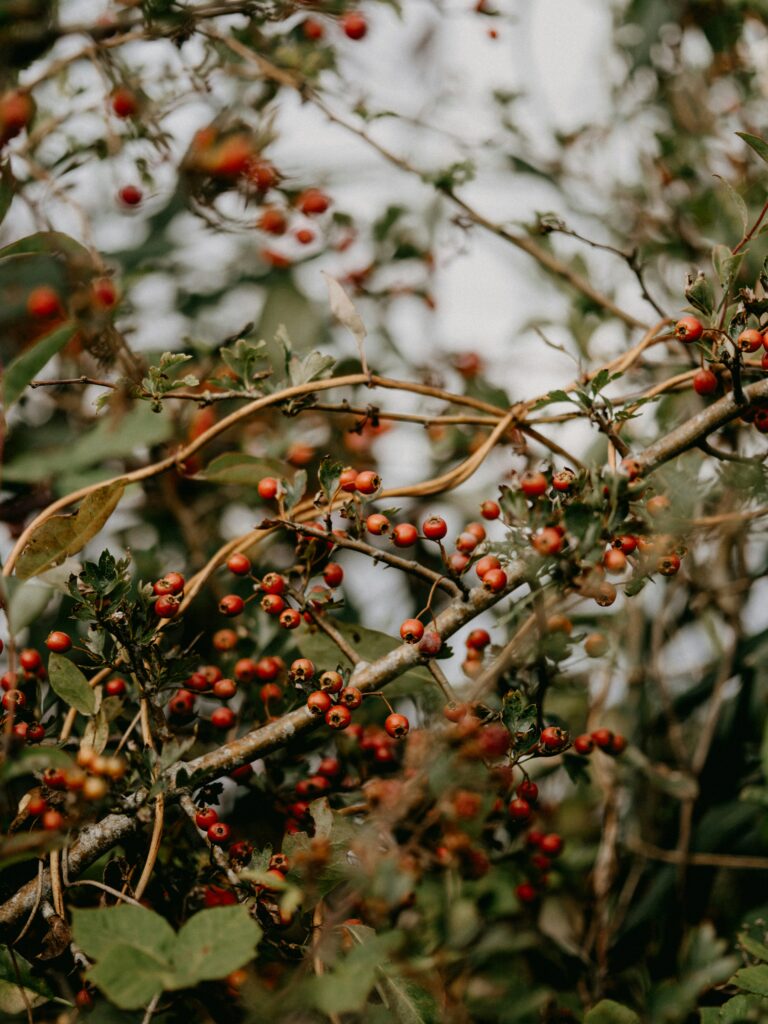
Consider the hawthorn hedge.
For centuries, British farmers planted this thorny, dense-branched tree along their property lines for one reason: it kept people out. The thorns were formidable. The branches tangled into an impenetrable barrier. It was, in essence, living barbed wire—a botanical “keep out” sign that did exactly what it was meant to do.
And yet.
When modern herbalists reach for hawthorn today, they reach for it precisely because of its capacity to open. To soften the walls we build around our hearts. To ease the constriction in our chests. To let blood flow where it has grown sluggish.
The plant that once divided property lines now helps dissolve the barriers within us.
This is not a metaphor. This is the strange, verifiable paradox at the centre of one of Britain’s most beloved medicinal plants. And understanding why requires us to reconsider what we think we know about boundaries themselves.
The Etymology of Enclosure
Start with the name.
“Haw” comes from the Old English haga—meaning hedge or enclosure. The “thorn” part needs no explanation. But the botanical name, Crataegus, reaches back even further, to the Greek kratos (strength) and akis (sharp). Strength and sharpness. Protection and power.
The ancients, it turns out, understood this plant as something formidable.
Hawthorn belongs to the Rosaceae family—the same family as wild rose and raspberry. All plants that know how to set boundaries. They offer beauty and nourishment, yes, but they demand respect. You cannot gather their gifts carelessly. The thorns insist upon attention, a slowing down, a certain kind of care.
In British folklore, hawthorn occupied an uneasy position. Cutting a hawthorn branch and bringing it indoors invited misfortune—yet leaving cut branches outside the door would keep witches at bay. The tree was associated with faeries and the Otherworld, with thresholds between states. To fall asleep beneath a hawthorn on Beltane was to risk being spirited away.
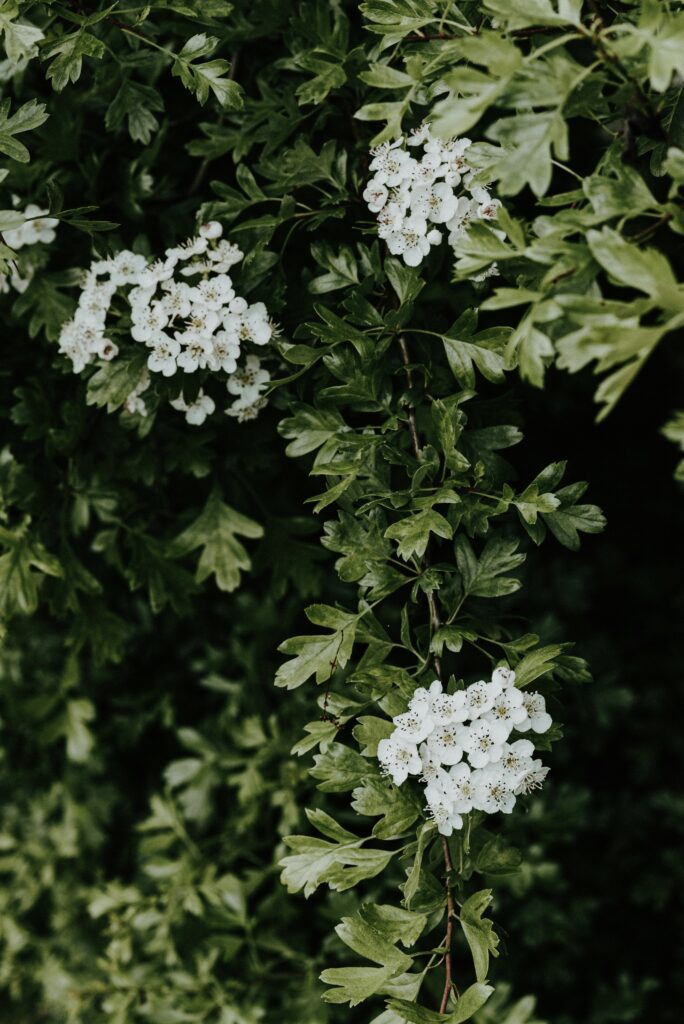
But here’s what’s curious: the Maypole—that symbol of community celebration, of spring’s arrival, of life bursting forth—was traditionally made from hawthorn wood. The tree blooms in early May, its white flowers appearing just as the light returns in earnest. When the Pilgrims named their ship the Mayflower, they weren’t thinking of a flower at all. They were thinking of this tree. Hawthorn represented hope, new beginnings, the courage to cross into unknown territory.
A plant of boundaries becomes a symbol of crossing them.
The pattern repeats itself, again and again, until you begin to wonder if we’ve been thinking about boundaries the wrong way all along.
What Hawthorn Does
In the body, hawthorn’s territory is the cardiovascular system. It has been used as a heart tonic across European traditions for centuries. And here’s the remarkable thing: modern research has largely confirmed what herbalists long observed.
The berries, leaves, and flowers all carry medicinal virtue. They contain flavonoids—particularly proanthocyanidins and anthocyanidins—that appear to support the integrity of blood vessel walls, improve coronary blood flow, and offer antioxidant protection to cardiac tissue. Studies have shown hawthorn may help maintain healthy cholesterol levels and support balanced blood pressure.
But what makes hawthorn unusual—what sets it apart from so many other remedies—is not simply what it does, but how it does it.
This is not a plant that forces the heart in one direction. It does not merely stimulate. It does not merely relax. Instead, it appears to normalize. Strengthening what is weak. Calming what is overactive. Bringing the cardiovascular system back toward its own equilibrium.
Herbalists have a term for this kind of action: “trophorestorative.” A remedy that nourishes and restores proper function to an organ over time. You do not take hawthorn for a week and expect transformation. You take it for months, even years, and gradually—almost imperceptibly—the heart remembers its own steady rhythm.
Energetics: Slightly warming, mildly astringent
Affinities: Cardiovascular system, emotional heart
Actions: Cardiac tonic, trophorestorative, antioxidant, hypotensive
Parts used: Berry, leaf, flower
Taste: Sweet-sour (berry), slightly astringent
The People Who Feel Stress in Their Hearts
There is another dimension to hawthorn’s work, and it moves beyond physiology into the territory of feeling.
Some people, when they become anxious or stressed, feel it in their stomachs. A churning. A loss of appetite. A knot. Others feel it in their minds—racing thoughts, mental loops, an inability to quiet the inner chatter.
But there is a third pattern, less often discussed.
There are people who feel stress in their hearts. Not metaphorically. Physically. A fluttering. A racing pulse. A tightness in the chest that makes them want to take a deep breath but somehow cannot.
For these individuals—this specific subset of people whose anxiety manifests as palpitations, whose grief sits heavy in the chest, whose emotional and physical hearts seem to be speaking the same difficult language—hawthorn offers particular comfort.
Some herbalists call it a “cardiac nervine.” A plant that calms not the mind directly, but the heart itself, and through the heart, the whole nervous system. When the chest softens, when the pulse steadies, a certain kind of peace becomes possible.
This is the plant to consider when someone speaks of heartache and means it literally.
How to Work With It
Hawthorn is gentle enough for long-term use and generally considered safe for most people. (Those on heart medications should consult a practitioner, as hawthorn may enhance the effects of certain cardiac drugs.)
The berries can be simmered into a decoction or macerated in brandy to make a cordial. The leaves and flowers, harvested in spring when the tree is in bloom, make a lighter tea. Many herbalists prefer to use all three parts together—the “leaf, flower, and berry” combination that captures the plant’s full expression.
There is a particular method worth trying: an overnight infusion. Place a tablespoon each of dried leaf, flower, and berry in a jar. Cover with just-boiled water and let it steep through the night. Strain in the morning and drink throughout the day. It tastes faintly sweet, faintly sour, faintly of something old and patient.
The Lesson of the Hedge
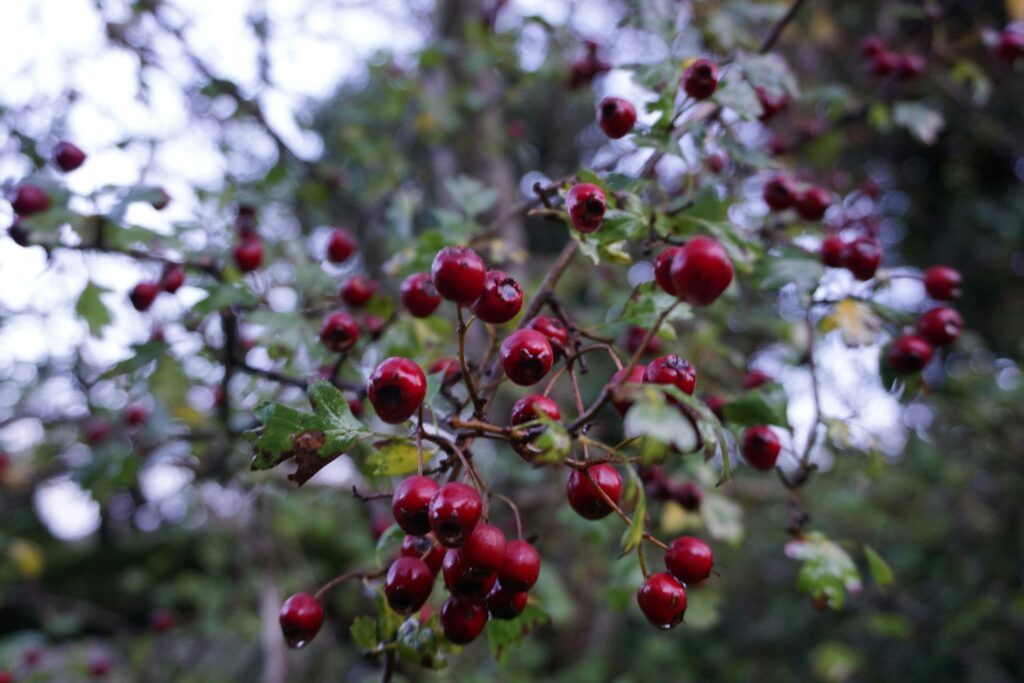
Walk through the British countryside in late autumn and you will find hawthorn everywhere. In hedgerows. At field boundaries. Standing alone on hillsides like sentinels. The same plant that farmers once used to keep people out.
Perhaps what hawthorn teaches us is that boundaries and openness are not opposites.
The same plant that forms an impenetrable hedge also dilates the coronary arteries. The same thorns that demand respect create the conditions for trust. In a culture that often swings between walls and exposure—between guarding ourselves fiercely and giving ourselves away entirely—hawthorn offers a quieter wisdom.
It suggests that real protection comes not from hardness but from strength. From a heart that is both boundaried and permeable. Both steady and soft.
The old herbalists understood this. They planted hawthorn at the edges of their land and took its berries for their hearts. They knew that what guards us and what heals us might, in the end, be the same thing.
If you find yourself drawn to this kind of slow, patient work with plants—learning to read their energetics, to match their virtues to individual constitutions, to understand healing as a conversation rather than a prescription—this is the ground we explore in our Green Files. It is a place to begin, or to deepen, your relationship with the green world and with your own capacity for care.
The hawthorn is blooming somewhere right now, or preparing to. The berries are ripening, or have just been gathered. The seasons turn, and the heart keeps its rhythm, and the old plants wait to be remembered.
Crataegus monogyna, C. laevigata, C. oxyacantha
Family: Rosaceae
Native to: Europe, including throughout the British Isles