The Substitution: How an American Plant Quietly Replaced a British Herb That Shares Its Name
- Roland Koronya


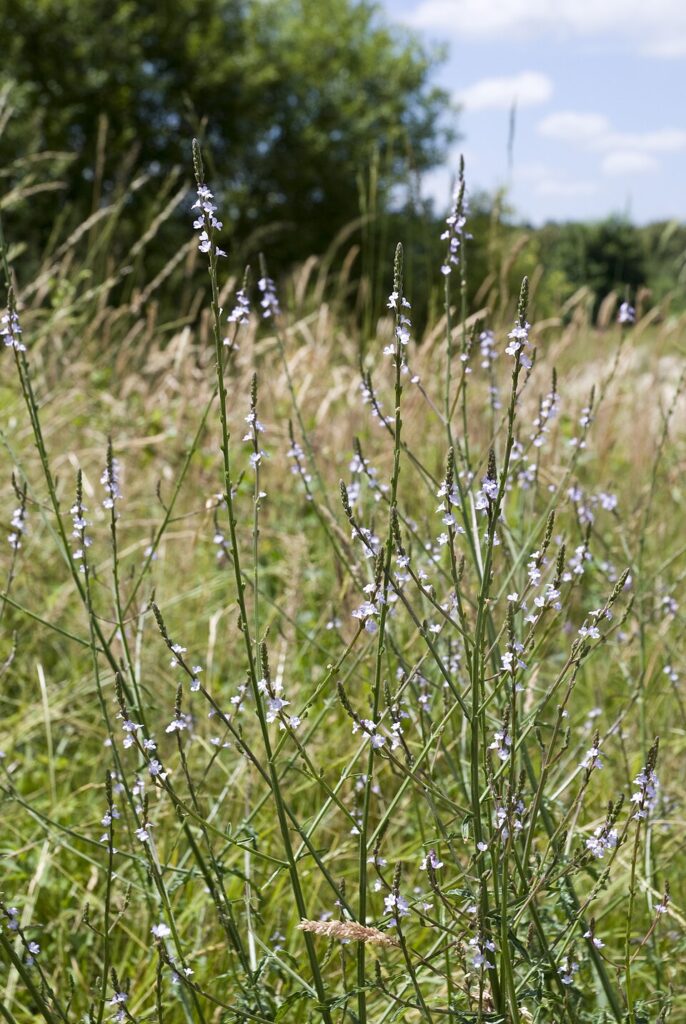
There is a plant growing on damp roadsides, river margins, and neglected patches of waste ground across Britain right now that nobody talks about.
It grows to about knee height. Its stem is square and wiry. Its leaves are small and toothed. Its flowers are so minute that most people, passing, mistake it for a weed, which it is, in the best sense of the word, meaning a plant that has found its own way into human company without anyone particularly inviting it.
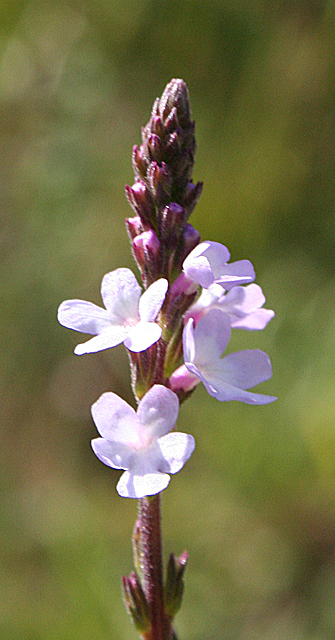
The flowers are a pale lilac-mauve, clustered on thin spikes. If you get close enough, and you almost never do, you can see that each one is a small, perfect thing.
This is Verbena officinalis. Common vervain.
The European plant. The British native. The one Culpeper wrote about, that the Druids considered sacred, that Maud Grieve described as one of the most ancient of all European magic herbs. A documented medicinal history stretching back to Rome, to Greece, to the earliest layers of British folk tradition.
It grows in every county in England and Wales. It has been here since at least the Iron Age.
The Reach
And yet if you walk into a British herbalist’s practice today and ask about vervain, there is a reasonable chance they will reach, instinctively, for a tincture of Verbena hastata.
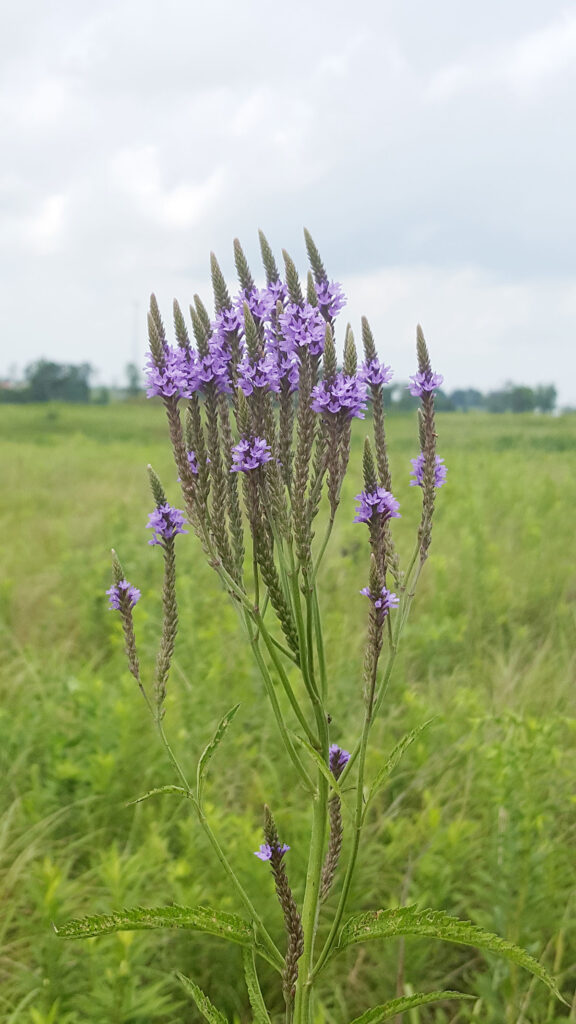
Blue vervain.
A North American plant, native to the wetlands of the United States and Canada, unknown in Europe until relatively recently, with no presence in the British folk tradition whatsoever.
Consider what this means. A herbalist standing in Britain, asked about a plant with two thousand years of documented British use, a plant quite possibly growing in the verge outside their own door, reaches instead for a species that travelled four thousand miles to do a job the native has been doing here since before the Romans arrived.
This is not a small irony. And it is not a case of reaching past the ordinary for the exotic. The substitution is stranger than that.
The two plants share a name. They address the same pattern. One of them simply isn’t from here.
The American
Let us be clear about the import, because it is genuinely excellent. This is not a story about a good plant being replaced by a bad one.
Blue vervain is bitter and acrid, two tastes that together announce nervine sedative and antispasmodic action. It is cooling, drying, and relaxant. It addresses the wind/tension tissue state: the pattern of excess nervous system activity that expresses itself as physical constriction, particularly in the upper body.
The specific affinity is documented consistently. Stiff shoulders. TMJ. Tension headaches that begin at the nape of the neck and radiate forward. The jaw that will not quite release. The person Matthew Wood describes as “strong above and weak below”, all the energy and tension concentrated in the head and chest, the lower body disconnected, the feet barely touching the ground.
The psychological portrait is equally precise. Blue vervain is the herb for the “avid listmaker”, the person with impossibly high standards for themselves and others, who cannot stop doing, who has forgotten that rest is a legitimate activity, who runs on caffeine and obligation until the system that has been keeping everything moving finally gives out.
This is not vague nervousness. It is a precise, constitutional picture: driven, tense, overworked, cooling into exhausted irritability when the load finally exceeds the capacity to carry it.
A few drops of the tincture are frequently sufficient. It is not a subtle medicine.
It is reliable, well-documented, and effective.
But
It is also North American.
It grows in swamps and wet meadows throughout the United States and Canada. It does not grow wild in Britain. It has no place in the British folk tradition.
And it cannot be foraged, grown from a handful of hedgerow seed, or found in the roadside flora by a British herbalist wanting to work with what the land around them actually offers.
Which raises the question the whole comparison turns on: is there anything the imported plant does that the native one, growing free, in every county, right now, cannot?
The Native
Verbena officinalis is a different plant in a different body.
Where blue vervain grows tall, robust, and visibly present, reaching a metre and a half, multiple flower spikes rising from a strong stem, common vervain is modest. Perhaps seventy centimetres on a good site. Thin, sparse flower spikes. Individual flowers so small they are easily overlooked.
It has the appearance of a plant that has learned to survive on almost nothing, which, in the disturbed, depleted, limey soils it prefers, it essentially has. It grows on roadsides, on chalk banks, on the edges of car parks and industrial sites, in the rubble of demolished buildings.
A weed, in the old sense. A plant of the marginal, the overlooked, the disturbed.
And yet the British folk tradition knew it as herba sacra, the sacred herb. The Romans considered it one of the most important plants in their religious rituals. The Druids used it in ceremony and medicine. Culpeper gave it extensively. Maud Grieve, in 1931, described it as one of the herbs most anciently held in reverence.
The taste profile is similar to blue vervain, bitter, acrid, slightly astringent, but lighter in all directions. Less intensely bitter. Less forcefully acrid.
This is a gentler plant by degree. Which means both its therapeutic range and its adverse effect risk are proportionally softer.
The Evidence
Here is where the assumption that the native must be inferior collapses.
The European Pharmacopoeia has included a monograph for Verbena officinalis since 2008, a regulatory standard that requires a substantial body of evidence and is one of the more demanding benchmarks in European herbal medicine.
Research published in 2020 in Planta Medica documents the richness of its phytochemistry: iridoids, phenylpropanoid glycosides, phenolic acids, flavonoids. A 2025 Estonian pharmaceutical study demonstrated strong anxiolytic and antidepressant effects from the standardised extract across multiple validated behavioural models.
The European tradition knew what it was doing.
And common vervain has affinities the American species does not share in equal measure. Its iridoid content gives it a quality of gentle, sustained nervous system support that differs from the sharper, more immediate antispasmodic action of blue vervain. It carries stronger anti-inflammatory properties. Some European traditions identify it more specifically for liver and gallbladder conditions. Its historical use as a wound herb (the herba sacra applied to purify wounds and temples alike) gives it a surface-acting, tissue-cleansing dimension not prominent in the American plant.
The native is not a weaker version of the import. It is a different instrument, tuned to a different part of the same range.
One Pattern, Two Plants
The pattern both herbs address is the same at its core: the wind/tension tissue state. The person running too hot and too fast in the upper body. The nervous system exerting its excess as physical constriction and psychological rigidity. The person who cannot switch off. The person holding everything together by force of will.
Blue vervain addresses this pattern with force and clarity. Its intensity makes it fast-acting and precise. It is the herb for the most entrenched version, the person who is clearly, visibly, dramatically overworked, whose neck is rigid, whose irritability has sharpened into something with edges.
Common vervain addresses the same pattern with more patience. It is the herb for the person in whom that pattern is developing or sustained rather than acute, the nervous system under moderate, chronic load for months rather than at crisis point. Its lighter bitterness and its confirmed anxiolytic and antidepressant activity make it better suited to long-term supportive use.
So the practical distinction is both clinical and geographical.
If the pattern is acute and entrenched, blue vervain’s precision is hard to match, and it will need to be sourced dried or cultivated, since it does not grow wild in Britain.
If the pattern is chronic and sustained, V. officinalis works as well or better.
And it is growing in the road verge outside. It can be tinctured fresh. It can be grown from seed in almost any British garden. It can be gathered on a walk in August.
How This Keeps Happening
There is a broader lesson in the two vervains that extends well beyond which to reach for in a clinical moment.
The displacement of V. officinalis by V. hastata did not happen because the British plant is inferior. The evidence suggests it is not. It happened because the transmission of knowledge about it broke down, and American herbalism (more vigorous in its recent literature) filled the gap with the herb it knew.
Blue vervain arrived in the British materia medica not through any assessment of whether it improved on what was already there. It arrived because the Americans writing and teaching about nervines had been working with it extensively, and British herbalists, learning from those sources, absorbed their plant list alongside their frameworks.
This is the same pattern as ashwagandha. The same pattern as goldenrod. A dozen other cases where a foreign herb has displaced a native equivalent not because the native was inadequate, but because nobody was writing about it with sufficient clarity and passion to keep it in the conversation.
The plant does not lose its virtues when we stop talking about it. It only loses its place in our attention.
It Needs Only To Be Recognised
Verbena officinalis is growing in every county in England.
Its flowers are opening on chalk banks and waste ground right now. It has been here through every chapter of British history and in every British herbal written before 1900. It has European Pharmacopoeia status, demonstrated anxiolytic activity in current research, and a clinical profile that addresses one of the most common constitutional patterns in modern British life, the person who cannot switch off, running too hot in the upper body, holding everything together by will.
It does not need to be imported.
It needs only to be recognised.
The vervain is in the road verge. It has been there for two thousand years. It is waiting for someone who knows what they are looking at.
Growing and Preparing Both
Common vervain (V. officinalis) establishes readily from seed in British gardens, preferring dry, free-draining, limey soil in full sun. It self-seeds freely and returns year after year. Harvest the aerial parts in full flower, July through August. Tincture fresh at 50–60% alcohol; dried herb at 40–50%. Combine with milky oats or wood betony for the depleted nervous system alongside the tense one; with agrimony where the liver and digestion are involved; with lemon balm where heat and agitation are prominent.
Blue vervain (V. hastata) can be grown in a sunny spot with reliable moisture, though it is not reliably perennial in colder parts of Britain. Tincture fresh at 60% alcohol; dried herb at 40–50%. A few drops is frequently sufficient, begin conservatively. Combine with chamomile and agrimony for the burned-out, irritable pattern with a digestive component; with linden and lemon balm where cardiovascular tension accompanies the musculoskeletal picture.
Both are contraindicated in pregnancy due to emmenagogue action.