Sacred Water: The Little Alchemist Growing in Every British Garden
- Roland Koronya


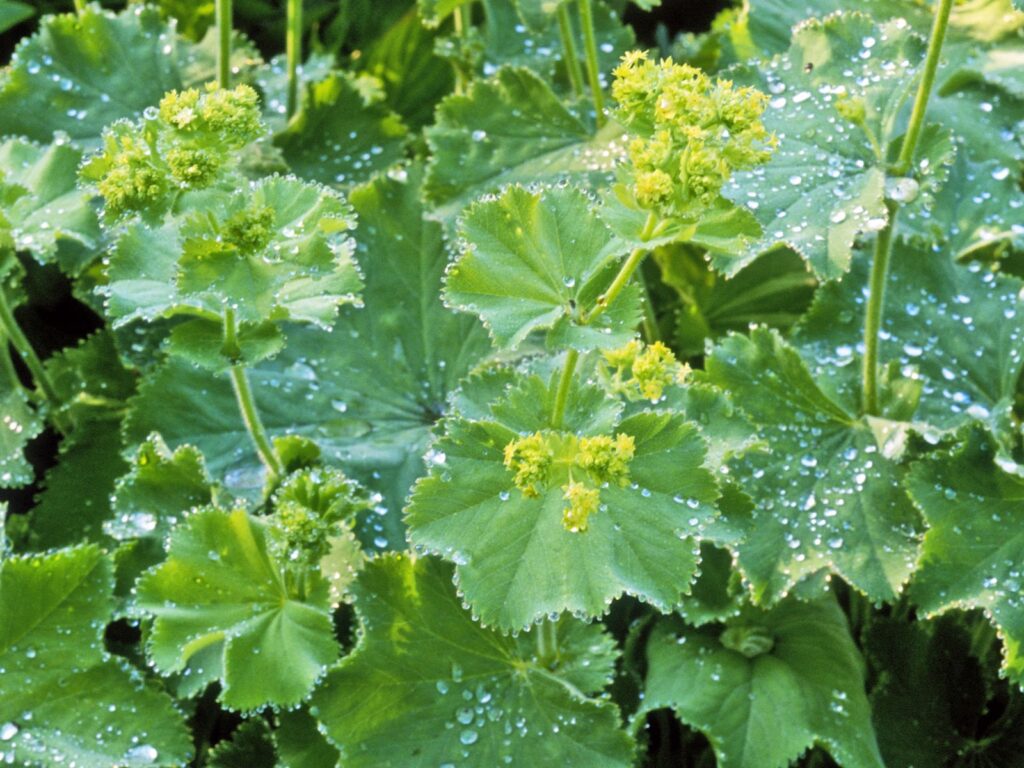
There is a moment, early on a damp British morning, when you almost can’t believe what you are seeing.
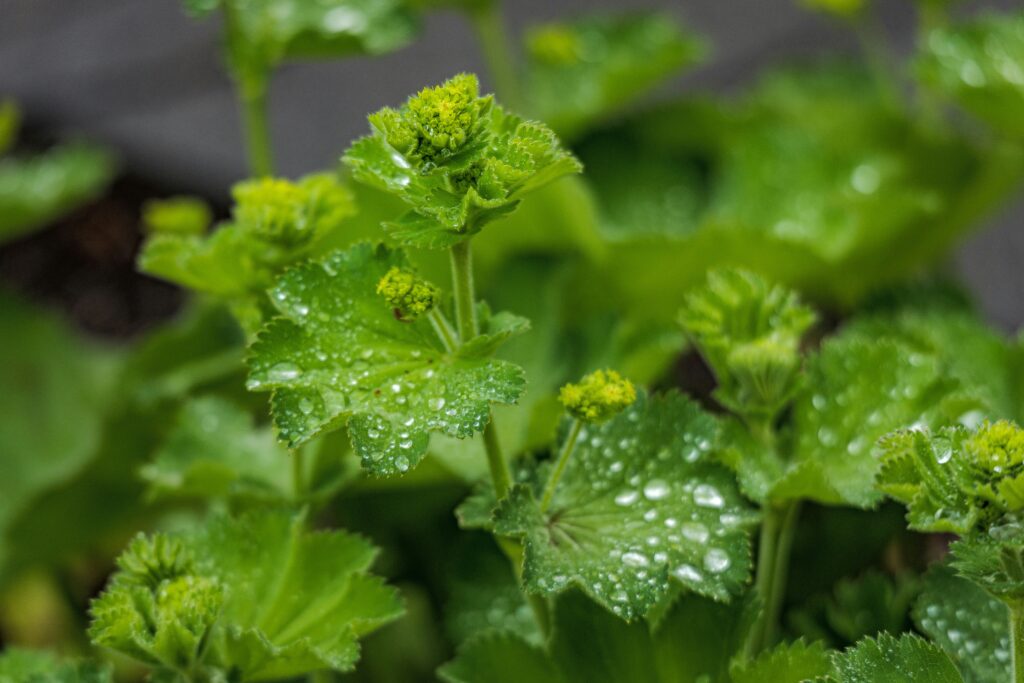
In the border of almost every cottage garden, tucked between the roses, spilling over path edges, quite unbothered by the weather Lady’s Mantle holds a small pool of water in the cup of each pleated leaf.
Not rainwater. Not dew exactly, though it looks like it.
The droplets form from within the plant itself, exuded from tiny pores at the leaf margin in a process botanists call guttation. Each leaf a perfect cup. Each cup holding water the plant has gathered from the air and offered back, as if in readiness for something.
For centuries, herbalists and alchemists had a simpler name for it: sacred water.
The Word
The genus name is Alchemilla.
The Arabian root of that name—Alkemelych—is the source of the English word alchemy itself.
This is not a minor etymological coincidence. Early alchemists would stake cloth in fields overnight to collect dew. Lady’s Mantle, with her cupped leaves gathering water from the air itself, was seen as nature performing the same act spontaneously. She was the alchemist’s vessel. A cup of the Water Element made plant. The 20th-century herbalist Maude Grieve cited old alchemical writers who believed the water held in those leaves carried powers of transformation, that it could be gathered in the early morning and used in the work of transmutation.
She has been growing in European gardens and moorland meadows for as long as anyone has been keeping records of plants. She appears in medieval herbals, in the writings of John Gerard, in the notebooks of folk midwives throughout the British Isles.
All of this history. And yet Lady’s Mantle remains one of the most quietly passed-over plants in the British herb garden.
She grows everywhere. She is used by almost no one.
The Puzzle
How does a plant whose name gave us the word “alchemy” become the plant that people walk past every morning on the way to the car?
Part of the answer is that Lady’s Mantle is not a dramatic herb.
She is small and soft-leaved, with pleated grey-green foliage that holds moisture and a froth of tiny yellow-green flowers in summer. Nothing about her announces itself as urgent or spectacular. She grows in the borders without drama, at home in the cottage garden in the way that useful, patient things tend to be at home, present, unhurried, waiting to be noticed.
Her action is the same.
The Single Gift
Lady’s Mantle tastes astringent. Strongly, unambiguously astringent: that puckering, drying sensation that draws the mouth tight and signals the presence of tannins.
She belongs to the Rosaceae family, sharing that tannin-rich character with rose, raspberry leaf, and agrimony.
Astringency speaks of tone: the tightening, binding, and contracting of tissues that have become too loose, too lax, too open.
This is the key to understanding everything Lady’s Mantle does.
Her single overriding gift is the restoration of structural integrity to tissues that have yielded, sagged, or become excessively porous. Not stimulation. Not sedation. Not warmth. Not force.
The old English herbalists described her as “of a very drying and binding character,” and that phrase remains the most accurate summary of her action. She works in the tissue state that vitalist herbalism calls damp/relaxation, the pattern that arises when something has become too open, too fluid, too permeable.
Excessive menstrual flow. Urinary leaking. The slow seepage of fluid into tissues that should be holding firm.
Not because the body has failed catastrophically. Because the tissue has simply yielded too far.
The Constitutional Picture
The herbalist William LeSassier identified a specific constitutional picture for Lady’s Mantle: the woman with a pale complexion and highly visible veins.
This is not aesthetic observation. It is clinical reading.
Pale skin with prominent veining points toward a deficit of structural tone in the venous system. The veins, unlike arteries, do not actively contract to assist blood flow. They are passive structures, dependent on their own structural tone to return blood to the heart against gravity.
When that tone is lost, blood pools.
The result is varicose veins. A sense of heaviness in the legs at the end of the day. Visible, prominent veining at the surface. A pattern of sluggish venous return that accumulates quietly over years.
Lady’s Mantle’s tannins tighten the venous wall. Her salicylate content thins stagnant blood. The dual action addresses both the structural cause and the fluid consequence of poor venous return.
The Three Territories
The female reproductive system is Lady’s Mantle’s central territory, and has been throughout her documented history.
Her primary action here is tonic and astringent: restoring functional tone to the uterus and pelvic floor when those tissues have become stretched, weakened, or atonic. Herbalists Deb Soule and David Hoffmann both document her traditional use for uterine prolapse, particularly following childbirth, where a daily tea of Lady’s Mantle combined with raspberry leaf was considered a standard restorative.
She is equally well established for heavy or prolonged menstrual bleeding, for spotting between cycles, and for vaginal discharge, all of them expressions of tissues that are releasing fluids they should be holding.
Her anti-inflammatory and astringent combination also makes her relevant during menopause, where hot, irritated, or lax pelvic tissue may be accompanied by sweating, discharge, or inflammation.
The venous circulation is the second major affinity, the pooling, the heaviness, the slow return of blood through walls that have lost their structural integrity. Already described. Already legible in the pale skin and visible veins that LeSassier identified.
The digestive system benefits from her astringency in conditions of excess permeability or laxity: loose bowels, gastric or intestinal ulceration, hernia where connective tissue has weakened.
The herbalist Matthew Wood notes her particular usefulness for what modern medicine calls intestinal hyperpermeability (the “leaky gut” pattern), where the same tissue-toning action applies at a microscopic level. The gut wall, like the venous wall, like the uterine wall, has become too open. Lady’s Mantle tones it back toward integrity.
Not By Force
A note on who she is for, and who she is not for.
The typical Lady’s Mantle constitution is pale, with visible veins, a tendency toward heaviness in the lower body, and a pattern of tissues that yield rather than hold.
She is not indicated for dry, tense, or depleted conditions. In those cases, her drying, toning action would only compound the problem. She suits bodies that run toward excess, laxity, and overflow.
In that clinical picture, she is precise, reliable, and quiet in her work.
We return, now, to that damp British morning and the cup of water held in the pleated leaf.
What the alchemists understood about Lady’s Mantle, what they encoded in the name they gave her and the reverence they accorded her is that she performs a particular kind of work in the world. She gathers what is dispersed. She holds what would otherwise run. She offers back, in concentrated form, what the air and the earth have given her.
Her medicine does the same.
Not by force. By restoration. By the patient, persistent toning of what has become too open, until the cup can hold what it was always meant to hold.